01Chapter 1 · The engine and the erg
Same work. Heart rate still climbing.
- Carousel
- The Why
- Rower
- Illustration
- Our rule
Slide 1 of 6
- One lab study
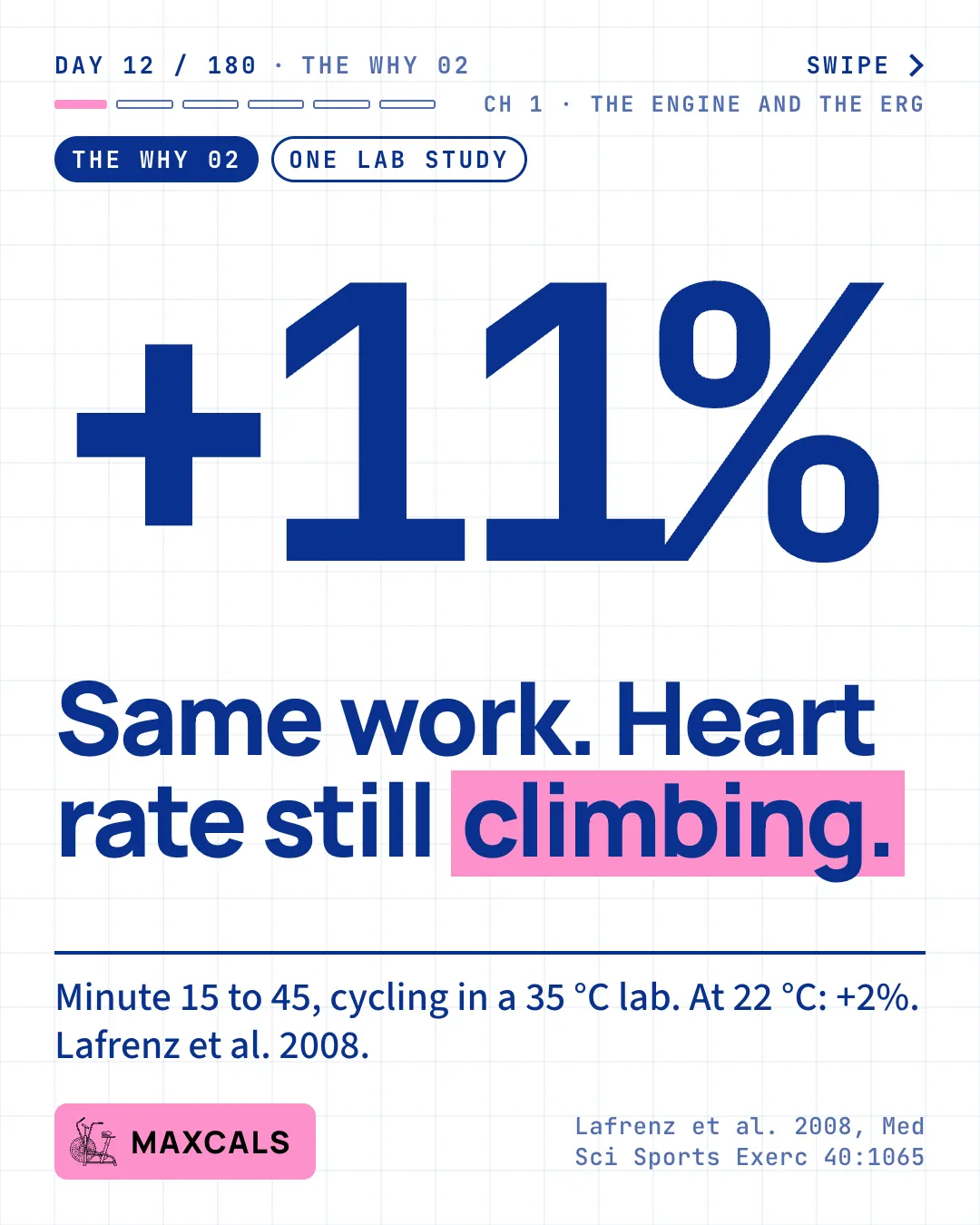
- Same work. Heart rate still climbing.
- +11%
- Minute 15 to 45, cycling in a 35 °C lab. At 22 °C: +2%. Lafrenz et al. 2008.
Slide 2 of 6
- 01 · Drift
- Illustration
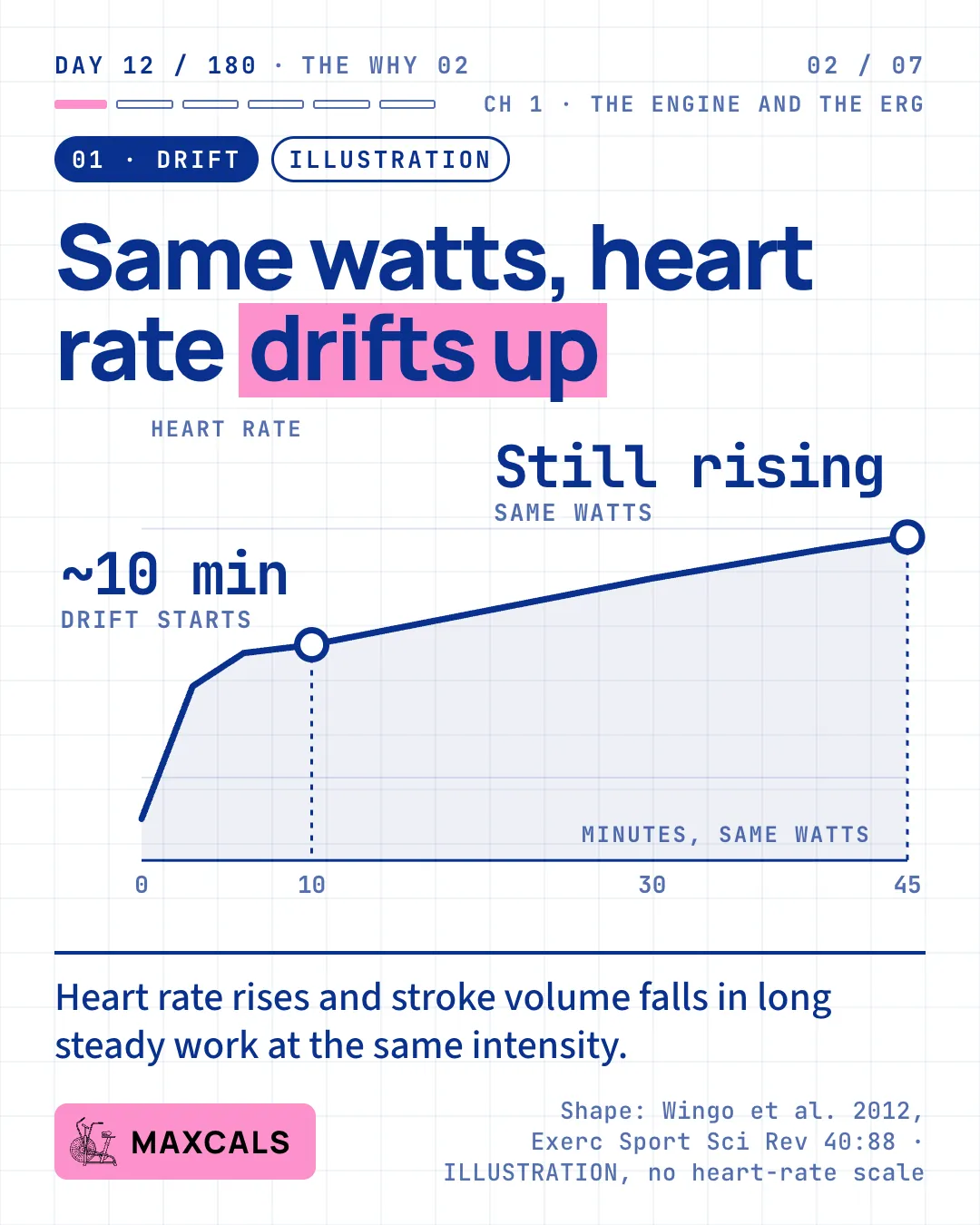
- Same watts, heart rate drifts up
- Heart rate rises and stroke volume falls in long steady work at the same intensity.
SourceShape: Wingo et al. 2012, Exerc Sport Sci Rev 40:88 · ILLUSTRATION, no heart-rate scale
Slide 3 of 6
- 02 · When
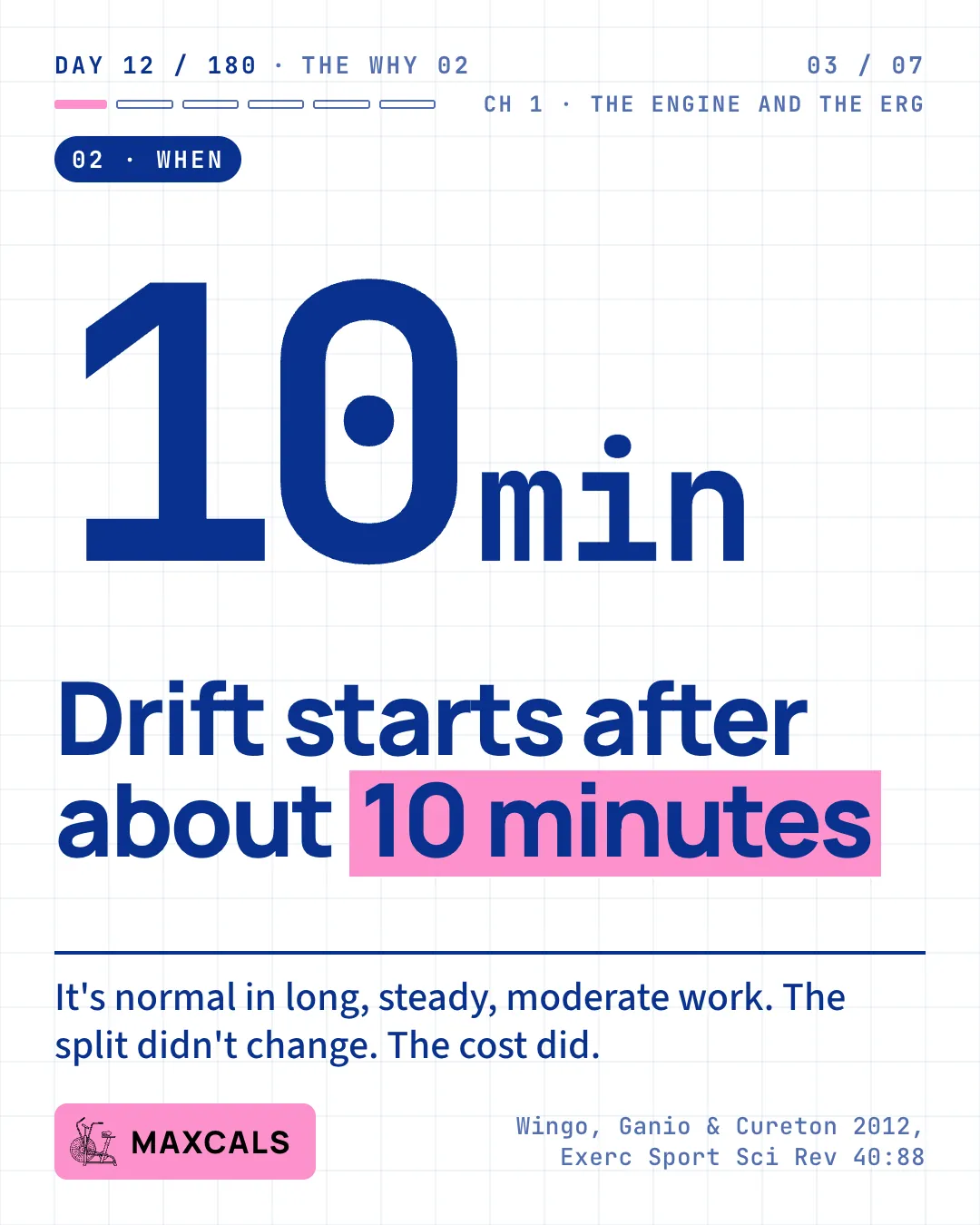
- Drift starts after about 10 minutes
- 10 min
- It's normal in long, steady, moderate work. The split didn't change. The cost did.
SourceWingo, Ganio & Cureton 2012, Exerc Sport Sci Rev 40:88
Slide 4 of 6
- 03 · Heat
- One lab study
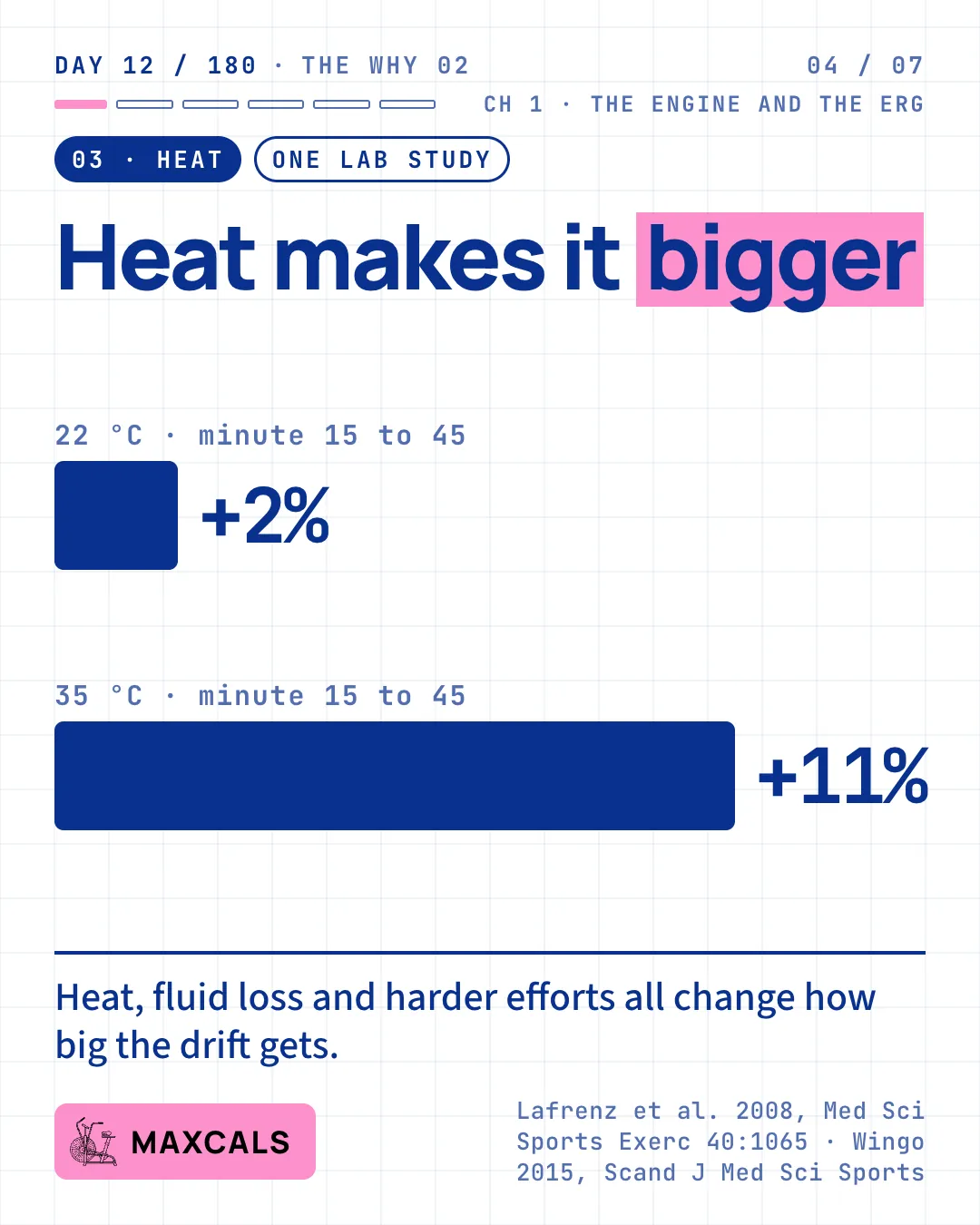
- Heat makes it bigger
- Heat, fluid loss and harder efforts all change how big the drift gets.
- 22 °C · minute 15 to 45 - +2%
- 35 °C · minute 15 to 45 - +11%
SourceLafrenz et al. 2008, Med Sci Sports Exerc 40:1065 · Wingo 2015, Scand J Med Sci Sports
Slide 5 of 6
- 04 · Fluid
- One lab study
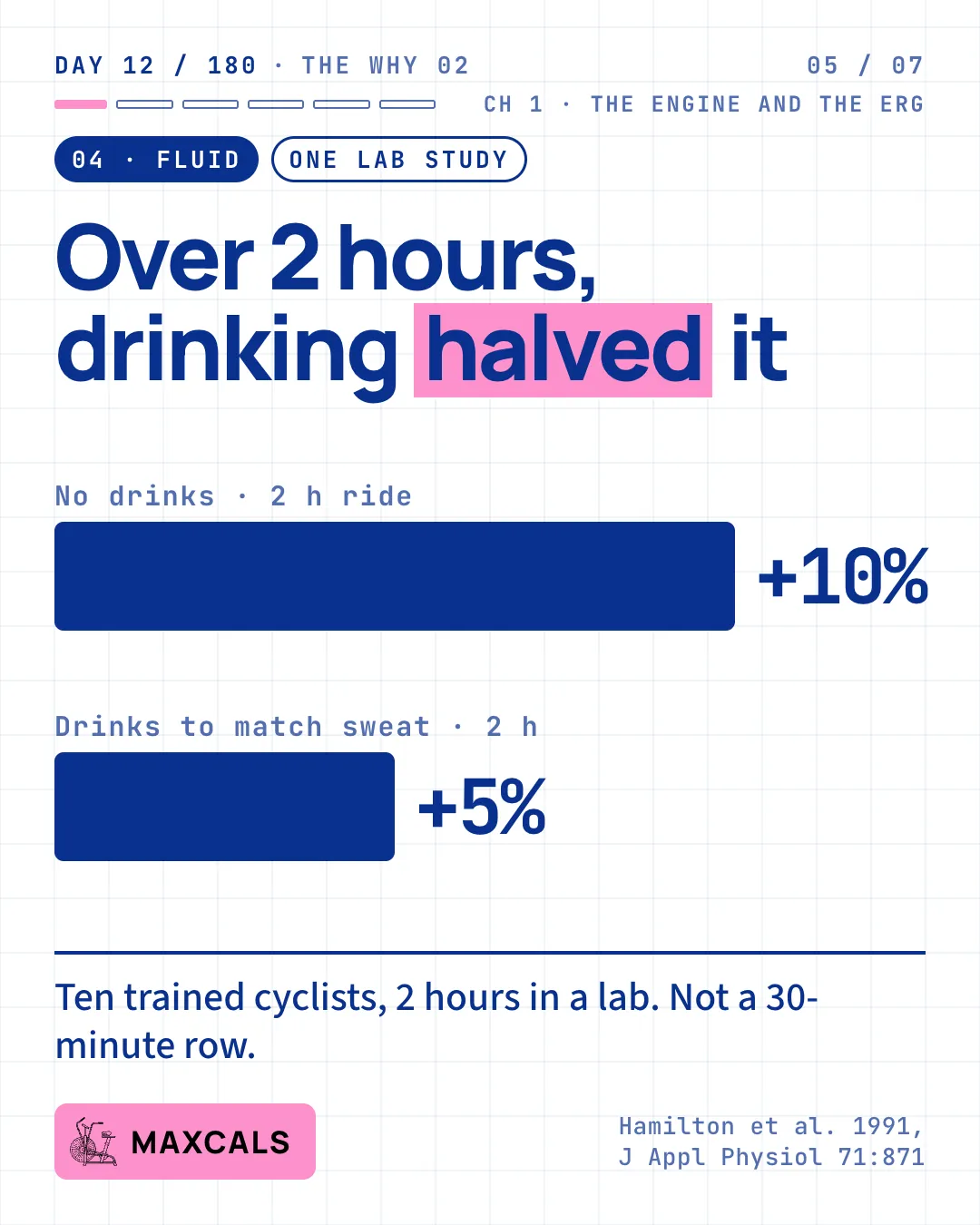
- Over 2 hours, drinking halved it
- Ten trained cyclists, 2 hours in a lab. Not a 30-minute row.
- No drinks · 2 h ride - +10%
- Drinks to match sweat · 2 h - +5%
SourceHamilton et al. 1991, J Appl Physiol 71:871
Slide 6 of 6
- 05 · Our rule
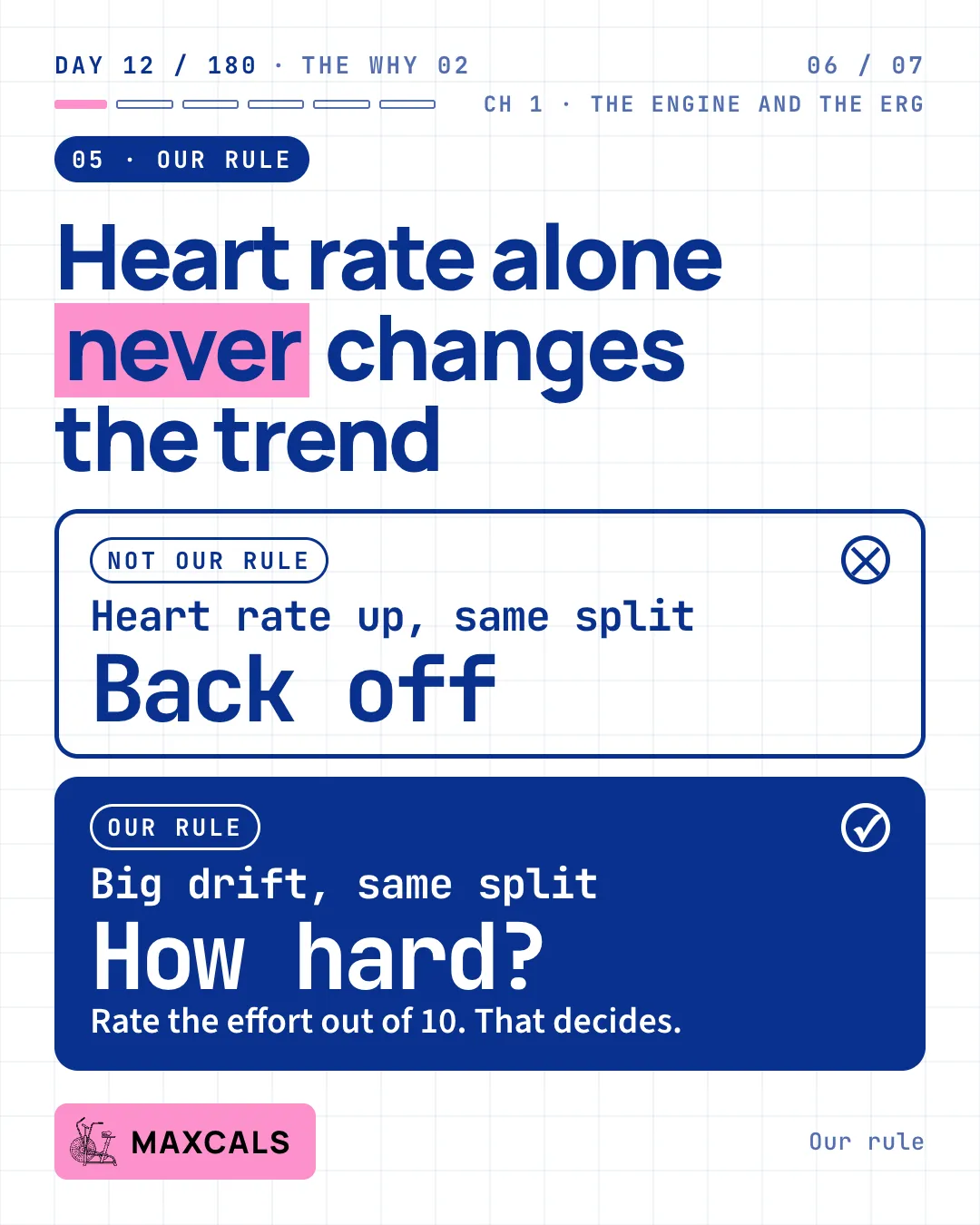
- Heart rate alone never changes the trend
SourceOur rule
In short
Same watts, and your heart rate still climbs. That's cardiovascular drift, and it happens to trained athletes too.
In long, steady work at the same intensity, heart rate rises and stroke volume falls, starting after about 10 minutes.
Heat makes it bigger. In one lab study, trained cyclists' heart rate rose 11% from minute 15 to 45 at 35 °C, and 2% at 22 °C.
Fluid matters too. Over a 2-hour ride, drinking to match sweat roughly halved the rise. That was a 2-hour lab ride, not a 30-minute row.
Our rule is heart rate alone never changes the trend. A big drift sends you to one question: how hard did that feel, out of 10?
How to run and pace each test, and how to read the result.
See the four engine testsSources
Paper
Wingo JE, Ganio MS, Cureton KJ (2012) Cardiovascular drift during heat stress: implications for exercise prescription. Exerc Sport Sci Rev 40(2):88-94. doi 10.1097/JES.0b013e31824c43af, PMID 22410803 ('the progressive increase in heart rate and decrease in stroke volume that begins after approximately 10 min of prolonged moderate-intensity exercise'; slides 2-3)
Paper
Lafrenz AJ, Wingo JE, Ganio MS, Cureton KJ (2008) Effect of ambient temperature on cardiovascular drift and maximal oxygen uptake. Med Sci Sports Exerc 40(6):1065-1071. doi 10.1249/MSS.0b013e3181666ed7, PMID 18461000 (10 endurance-trained men, cycling at ~59% VO2max, fluids replaced: HR +11% from min 15 to 45 at 35 °C vs +2% at 22 °C; cover and slide 4)
Paper
Hamilton MT, Gonzalez-Alonso J, Montain SJ, Coyle EF (1991) Fluid replacement and glucose infusion during exercise prevent cardiovascular drift. J Appl Physiol 71(3):871-877. doi 10.1152/jappl.1991.71.3.871, PMID 1757323 (10 endurance-trained subjects, 2 h cycling from 70% VO2max at 22 °C: HR +10% with no fluid vs +5% with full fluid replacement, 20-120 min; slide 5; abstract truncated on PubMed)
Paper
Wingo JE (2015) Exercise intensity prescription during heat stress: a brief review. Scand J Med Sci Sports 25 Suppl 1:90-95. doi 10.1111/sms.12381, PMID 25943659 (drift magnitude modulated by hyperthermia, dehydration, exercise intensity and ambient temperature; slide 4 body)
Paper
Coyle EF, González-Alonso J (2001) Cardiovascular drift during prolonged exercise: new perspectives. Exerc Sport Sci Rev 29(2):88-92. doi 10.1097/00003677-200104000-00009, PMID 11337829 (background only: they propose the stroke-volume fall is mainly due to the rising heart rate; no cause is stated on slides)
Nothing here is medical advice. The tests are maximal efforts: if you have a health condition or any doubt about training this hard, check with a doctor first, and stop if you feel unwell.