01Chapter 1 · The engine and the erg
Every row starts with an oxygen deficit
- Carousel
- The Engine
- Rower
- Illustration
Slide 1 of 6
- Every row starts with an oxygen deficit
- O₂
- Demand jumps on stroke one. Oxygen uptake takes time to catch up. Jones & Burnley 2009.
Slide 2 of 6
- 01 · The start
- Illustration
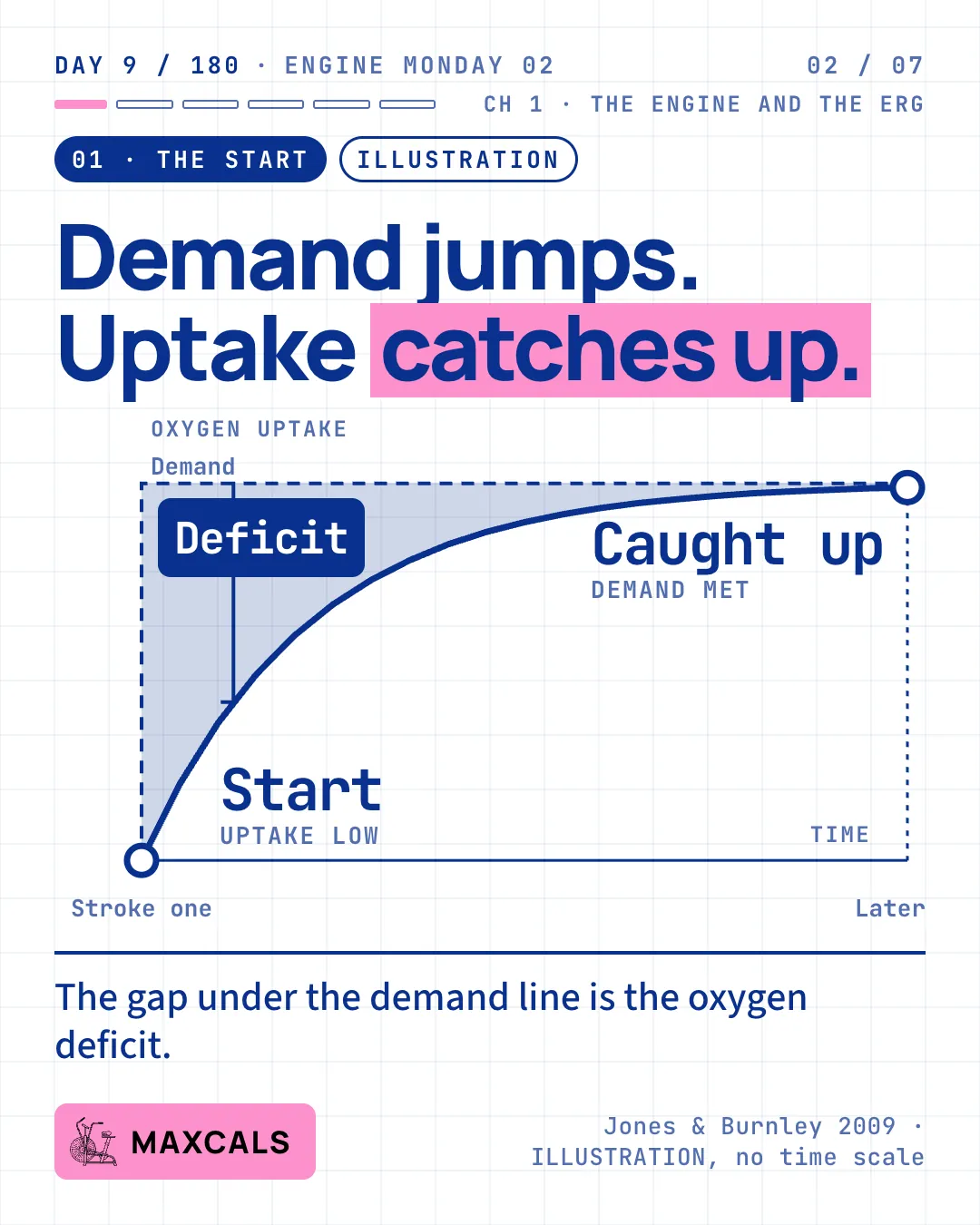
- Demand jumps. Uptake catches up.
- The gap under the demand line is the oxygen deficit.
SourceJones & Burnley 2009 · ILLUSTRATION, no time scale
Slide 3 of 6
- 02 · The gap
- Energy without oxygen covers the gap
- O₂
- Until uptake catches up, part of the energy comes from systems that don't use oxygen.
SourcePoole & Jones 2012, Compr Physiol 2:933
Slide 4 of 6
- 03 · Faster uptake
- Illustration
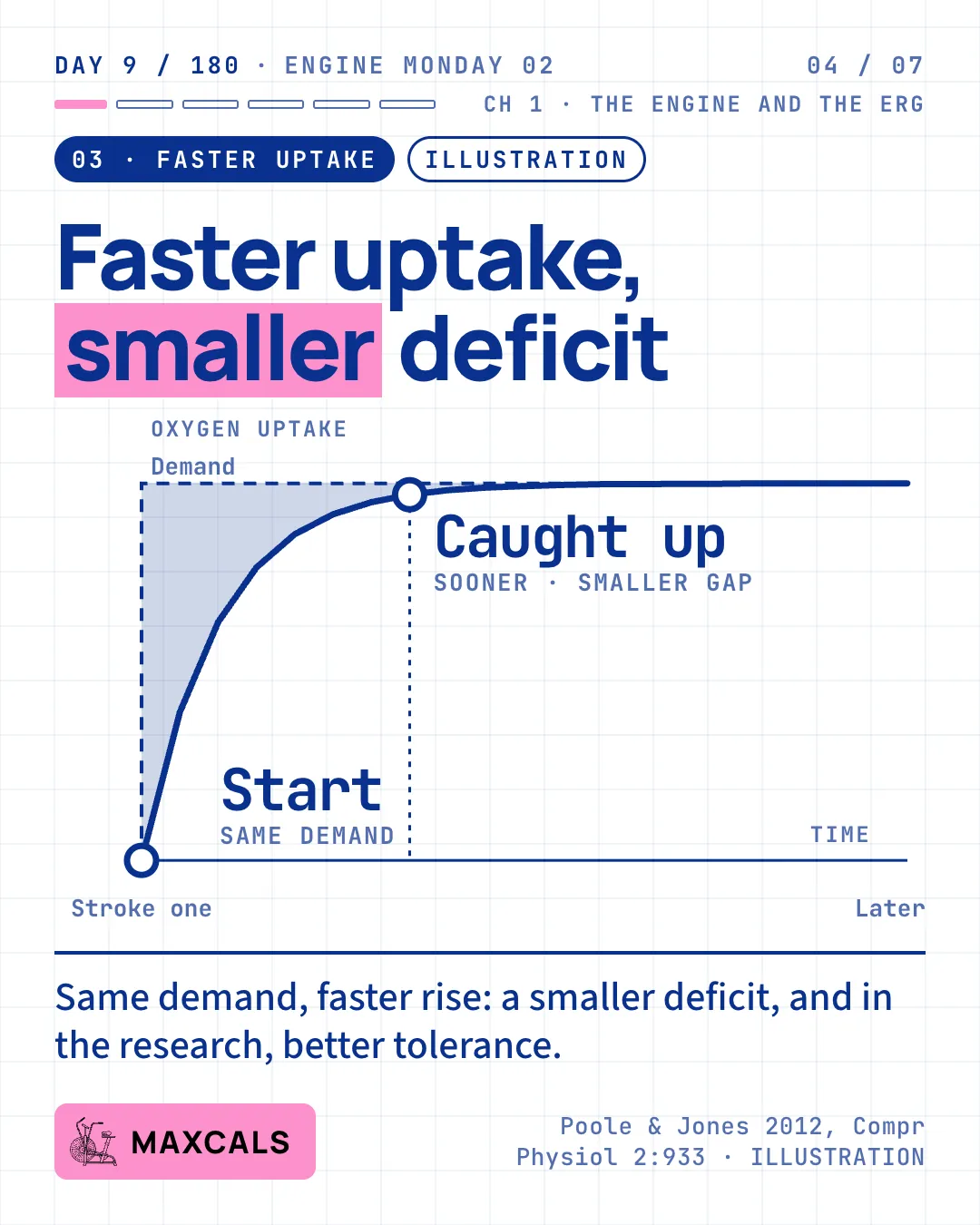
- Faster uptake, smaller deficit
- Same demand, faster rise: a smaller deficit, and in the research, better tolerance.
SourcePoole & Jones 2012, Compr Physiol 2:933 · ILLUSTRATION
Slide 5 of 6
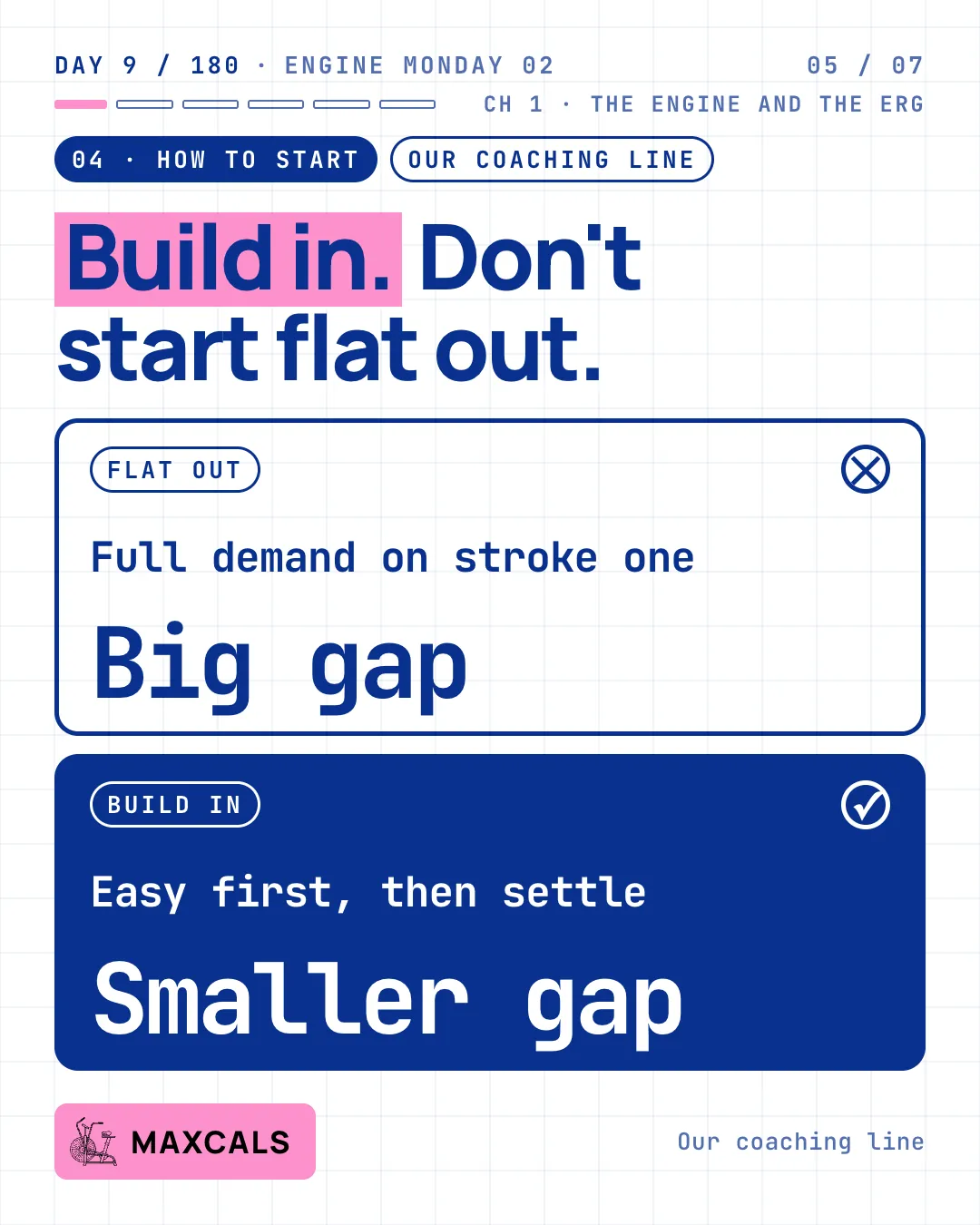
- 04 · How to start
- Our coaching line
- Build in. Don't start flat out.
SourceOur coaching line
Slide 6 of 6
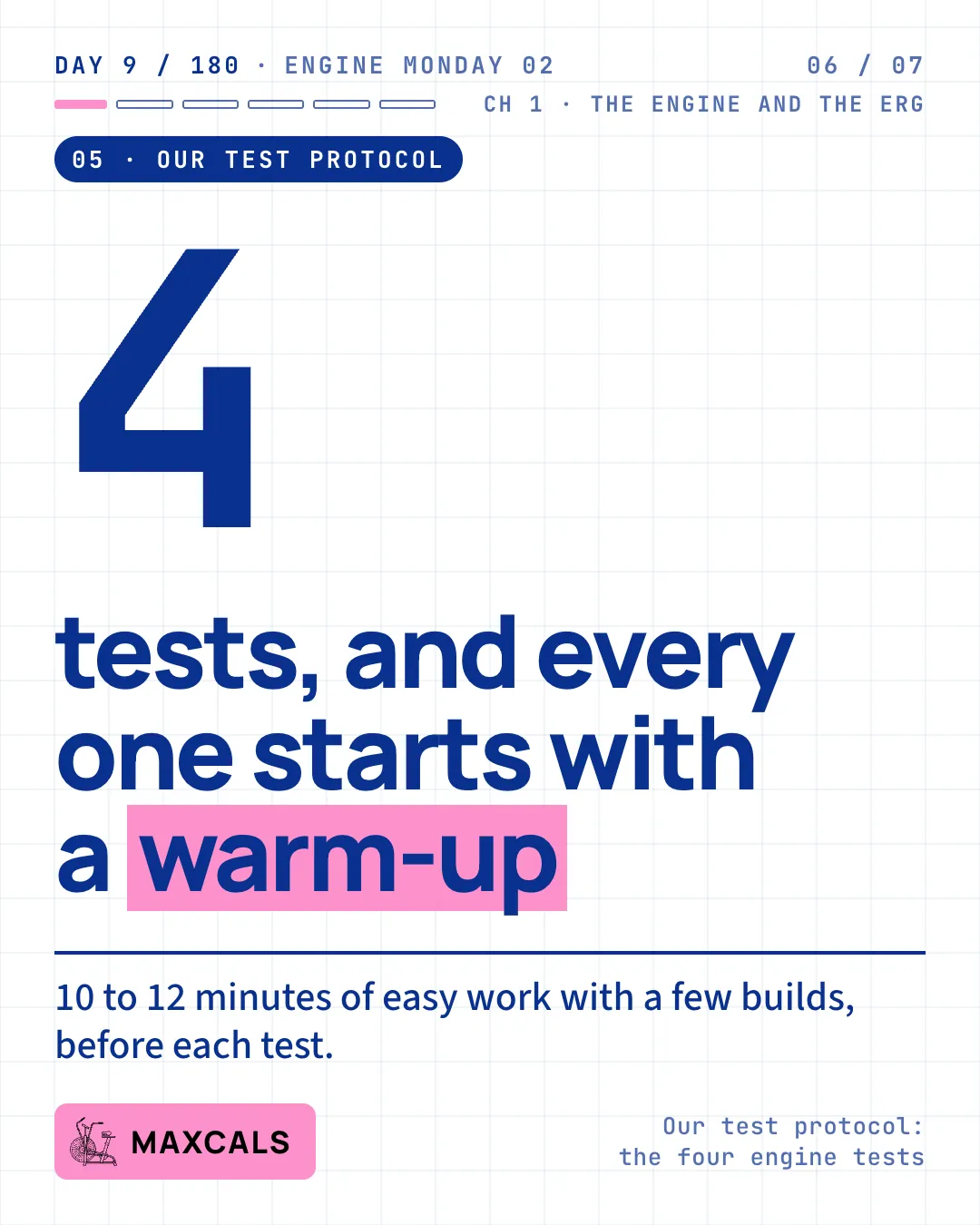
- 05 · Our test protocol
- tests, and every one starts with a warm-up
- 4
- 10 to 12 minutes of easy work with a few builds, before each test.
SourceOur test protocol: the four engine tests
In short
Engine Monday: every row starts with an oxygen deficit.
On stroke one the demand jumps. Your oxygen uptake takes time to rise and meet it.
The gap between the two is the oxygen deficit. Energy that doesn't need oxygen covers it.
A faster rise means a smaller deficit, and in the research, better tolerance of the work.
So build into a session instead of starting flat out. That part is our coaching line.
Every test in our protocol starts with a 10 to 12 minute warm-up.
How to run and pace each test, and how to read the result.
See the four engine testsSources
Paper
Jones AM, Burnley M (2009) Oxygen uptake kinetics: an underappreciated determinant of exercise performance. Int J Sports Physiol Perform 4(4):524-532. doi 10.1123/ijspp.4.4.524, PMID 20029103 ('The rate at which VO2 adjusts to the new energy demand following the onset of exercise strongly influences the magnitude of the O2 deficit'; cover, slide 2)
Paper
Poole DC, Jones AM (2012) Oxygen uptake kinetics. Compr Physiol 2(2):933-996. doi 10.1002/cphy.c100072, PMID 23798293 ('For a given metabolic demand, fast VO2 kinetics mandates a smaller O2 deficit, less substrate-level phosphorylation and high exercise tolerance'; slides 3-4)
Ours
Our coaching line, not a paper: 'build into a session'
Ours
Our test protocol: the four engine tests as set out on the Engine tests page.
Nothing here is medical advice. The tests are maximal efforts: if you have a health condition or any doubt about training this hard, check with a doctor first, and stop if you feel unwell.