01Chapter 1 · The engine and the erg
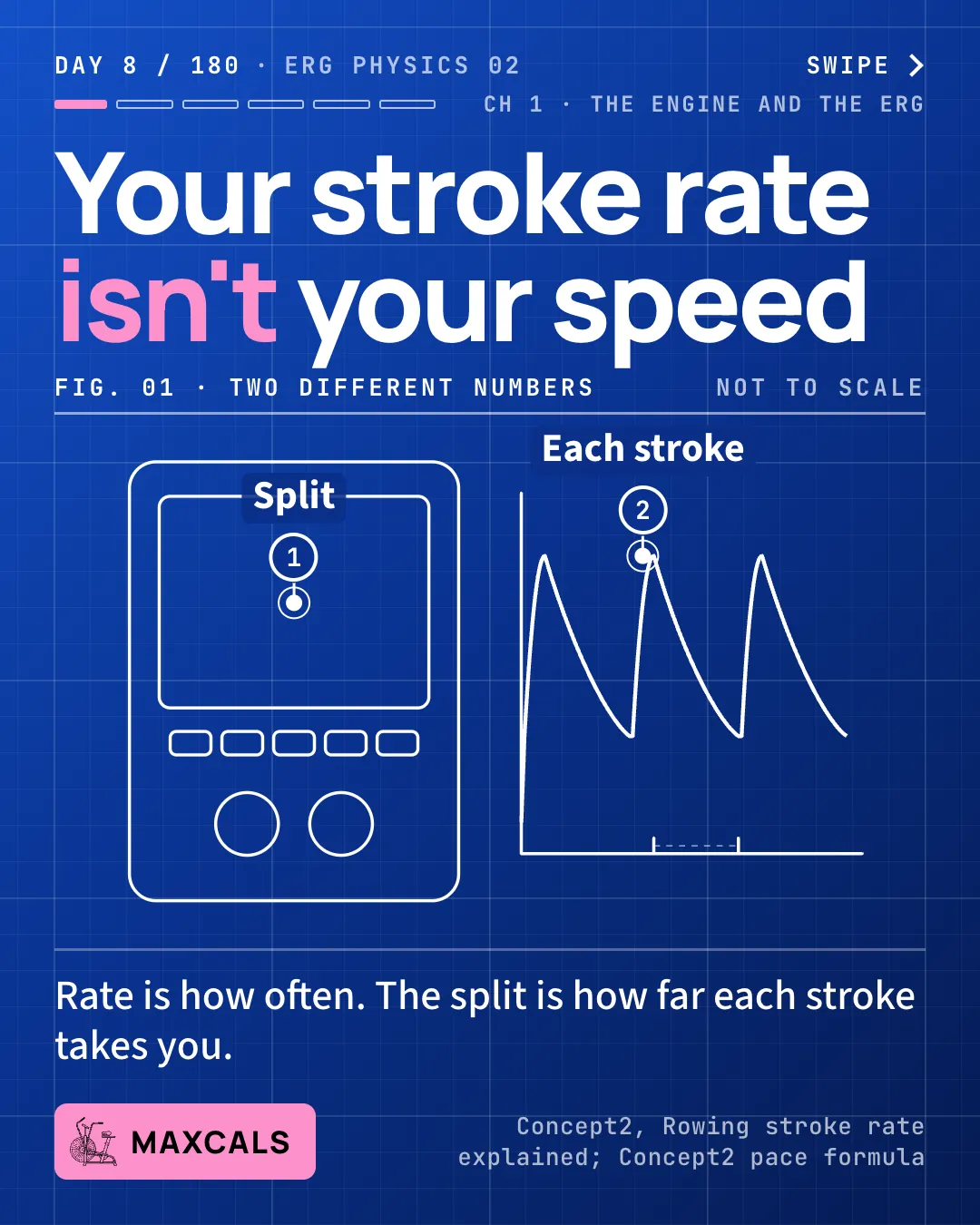
Your stroke rate isn't your speed
- Carousel
- Erg Physics
- Rower
- Example
Slide 1 of 5
- Your stroke rate isn't your speed
- Rate is how often. The split is how far each stroke takes you.
- Split
- Each stroke
Slide 2 of 5
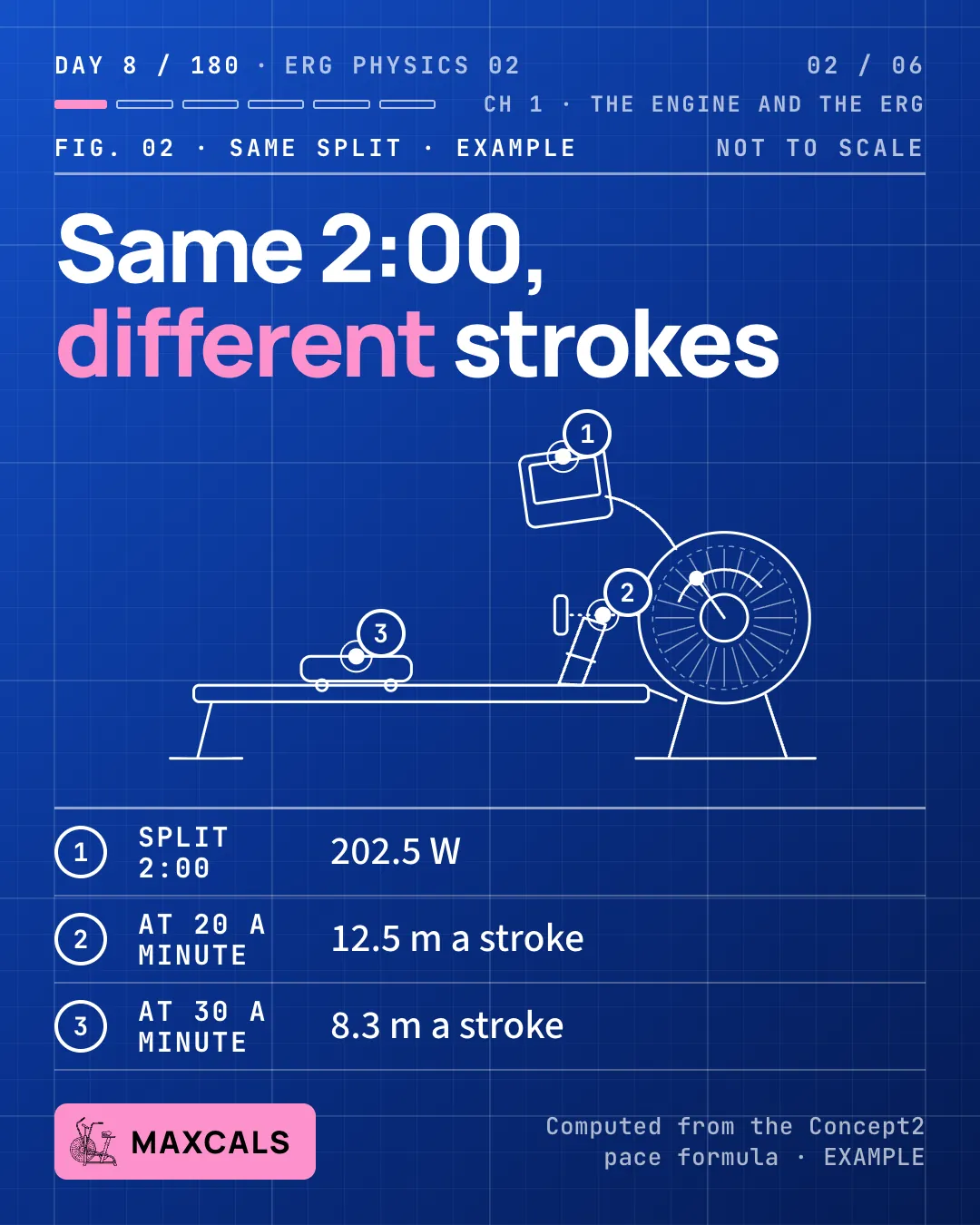
- Fig. 02 · Same split · Example
- Same 2:00, different strokes
- 1 - Split 2:00 - 202.5 W
- 2 - At 20 a minute - 12.5 m a stroke
- 3 - At 30 a minute - 8.3 m a stroke
SourceComputed from the Concept2 pace formula · EXAMPLE
Slide 3 of 5
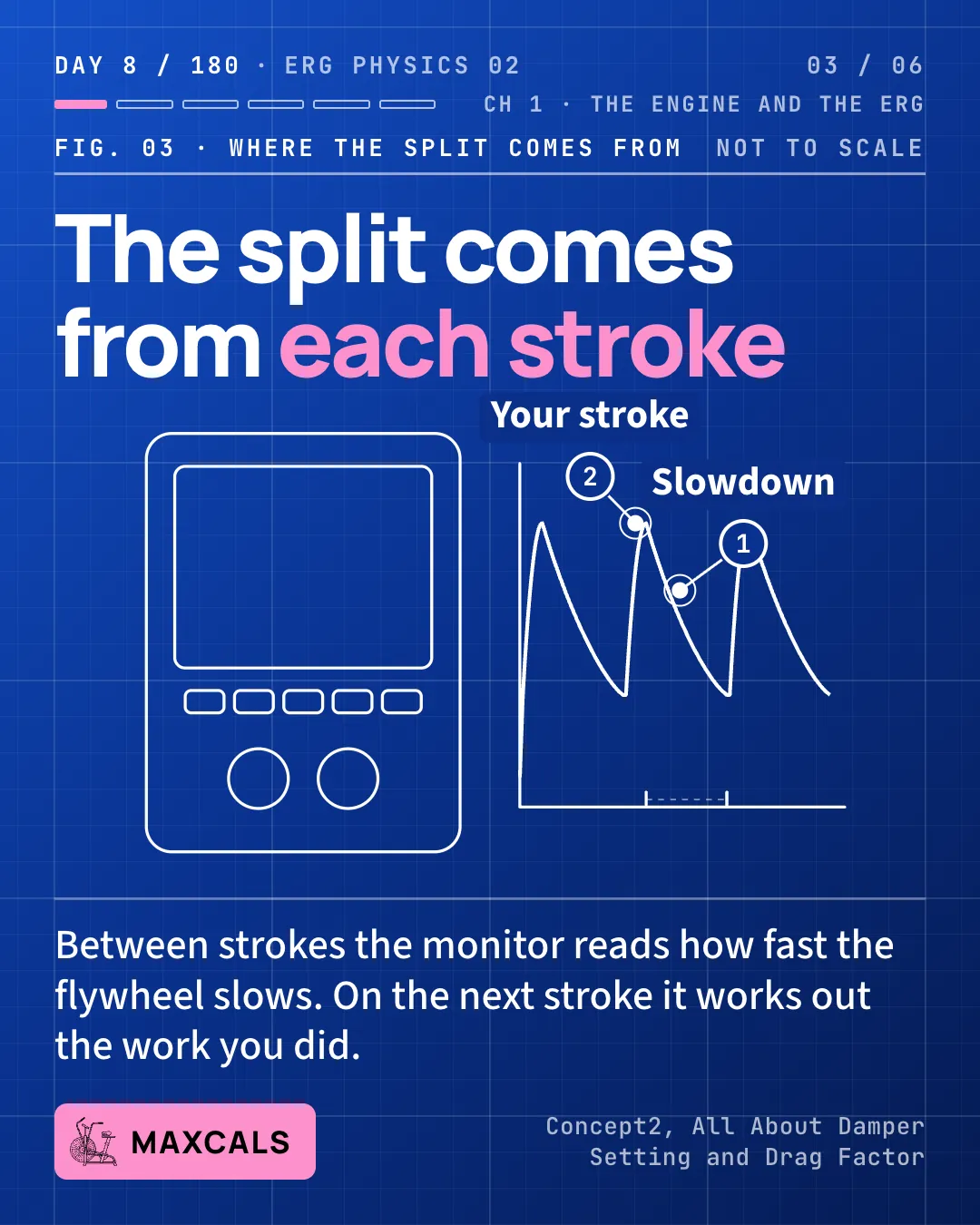
- Fig. 03 · Where the split comes from
- The split comes from each stroke
- Between strokes the monitor reads how fast the flywheel slows. On the next stroke it works out the work you did.
- Slowdown
- Your stroke
SourceConcept2, All About Damper Setting and Drag Factor
Slide 4 of 5
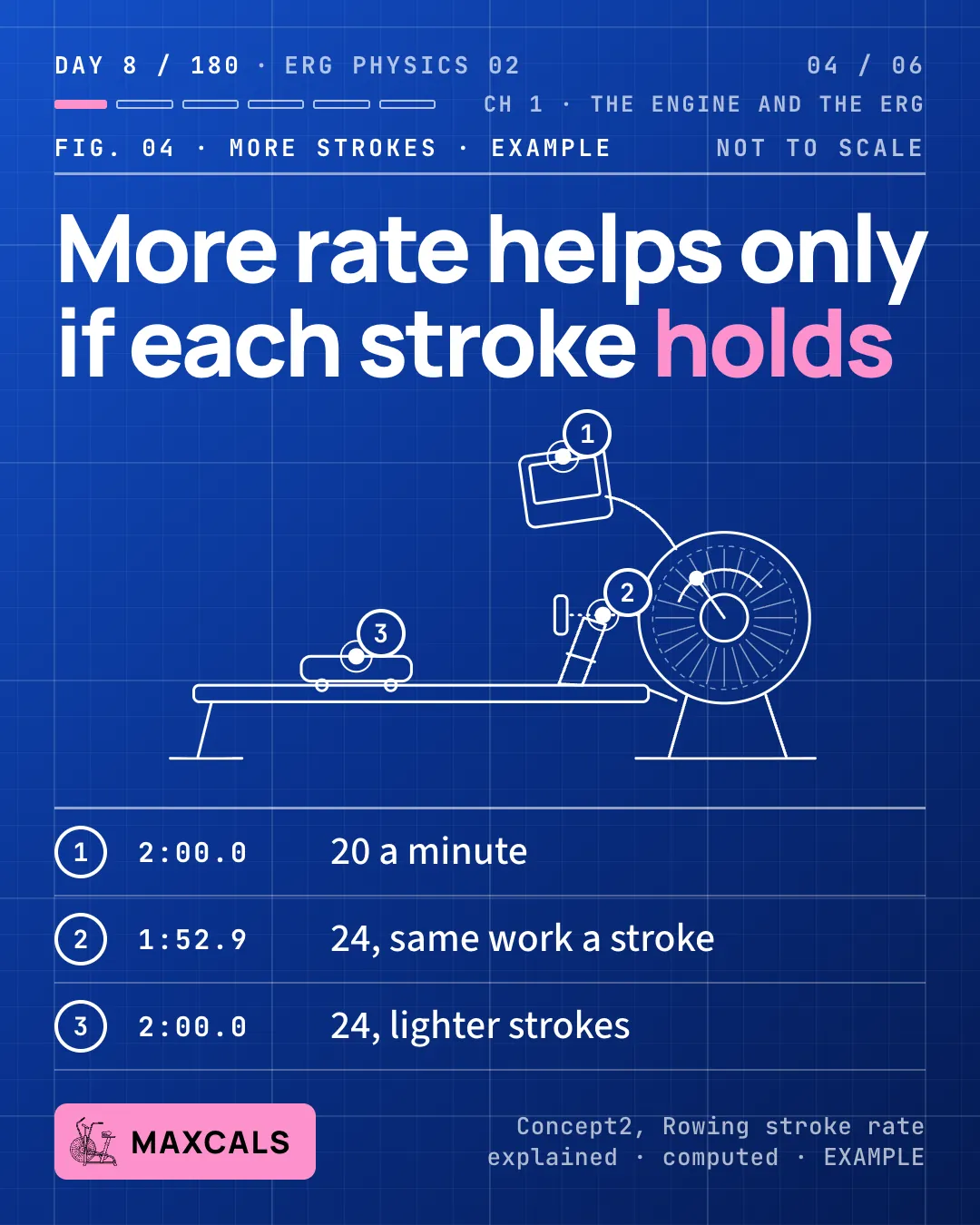
- Fig. 04 · More strokes · Example
- More rate helps only if each stroke holds
- 1 - 2:00.0 - 20 a minute
- 2 - 1:52.9 - 24, same work a stroke
- 3 - 2:00.0 - 24, lighter strokes
SourceConcept2, Rowing stroke rate explained · computed · EXAMPLE
Slide 5 of 5
- Fig. 05 · Steady work
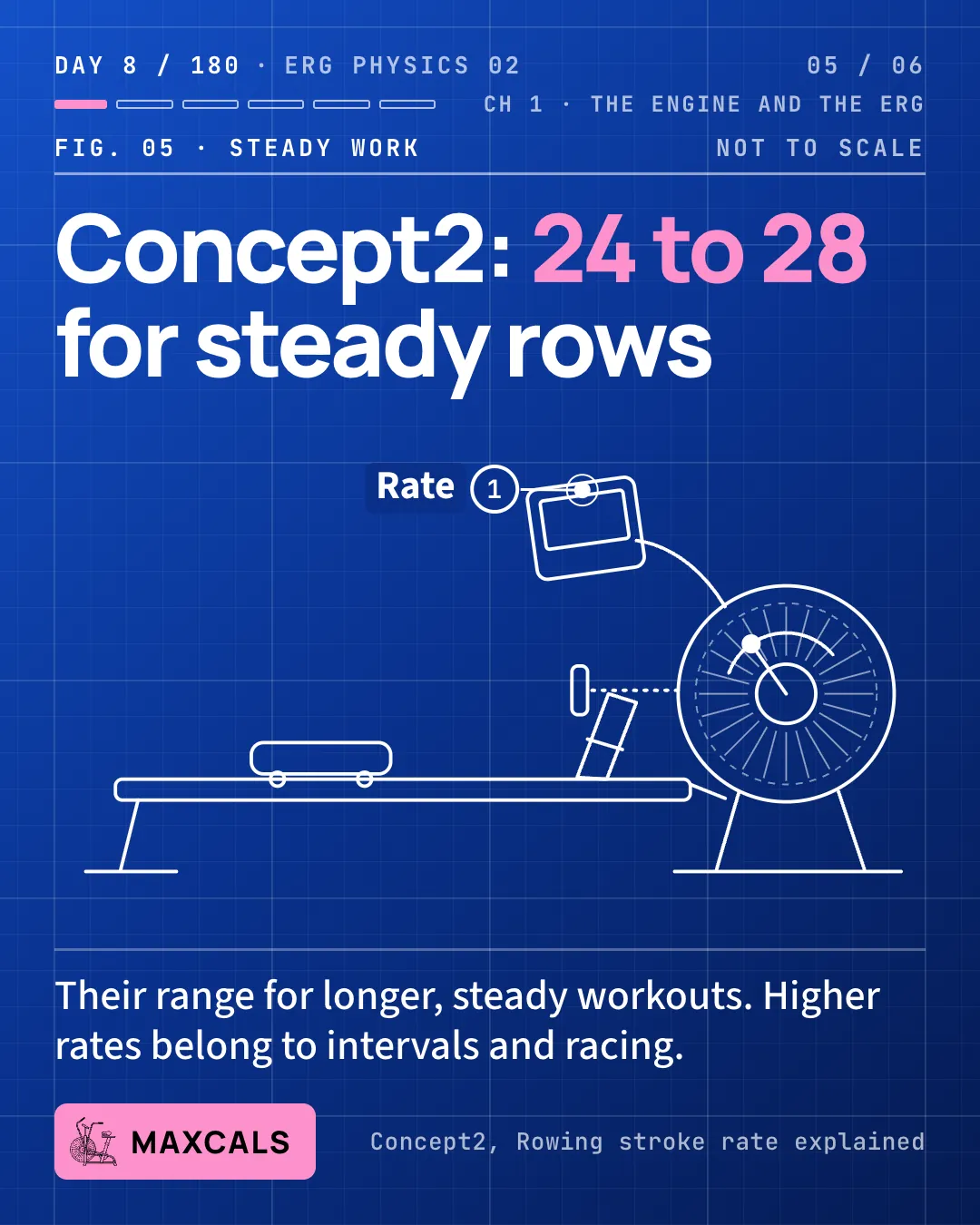
- Concept2: 24 to 28 for steady rows
- Their range for longer, steady workouts. Higher rates belong to intervals and racing.
- Rate
SourceConcept2, Rowing stroke rate explained
In short
Stroke rate is how often you pull. The split is how far each pull takes you. They're different numbers.
At a 2:00 split you're making 202.5 W either way. At 20 strokes a minute each stroke carries you 12.5 m. At 30, 8.3 m.
Raise the rate from 20 to 24 and keep the same work in every stroke, and the split drops to 1:52.9.
Raise it with shorter, lighter strokes and the split doesn't move.
Concept2's line: a higher rate means a faster piece only if technique and intensity hold on every stroke. They suggest 24 to 28 for steady work.
Every split here is an EXAMPLE, worked from Concept2's pace formula.
Turn pace into watts, and watts into pace, on any Concept2 erg.
Open the machine converterSources
Concept2 / web
Concept2, Rowing stroke rate explained, concept2.com/news/rowing-stroke-rate-explained: 24-28 spm 'tend to be comfortable for steady state workouts' / 'recommended for longer workouts'; 'If you're able to maintain the same technique and intensity on every stroke, a higher stroke rate means a faster performance'; 'Higher stroke rates are best practiced with interval training and for racing distances up to 2000 meters'
Concept2 / web
Concept2, All About Damper Setting and Drag Factor, concept2.com/training/articles/damper-setting: 'Between each stroke, the PM measures how much your flywheel is slowing down ... On your next stroke, the PM uses the drag factor to determine from the speed of the flywheel how much work you are doing'
Worked out
Computed (physics + Concept2 formula): 2:00 = 202.5 W; speed 4.1667 m/s; metres per stroke at 20 spm = 12.50, at 30 = 8.33; work per stroke at 20 = 607.6 J, at 30 = 405.1 J; same 607.6 J at 24 spm = 243.1 W = 1:52.92; at 24 spm with 506.37 J per stroke = 202.5 W = 2:00.0
Nothing here is medical advice. The tests are maximal efforts: if you have a health condition or any doubt about training this hard, check with a doctor first, and stop if you feel unwell.