01Chapter 1 · The engine and the erg
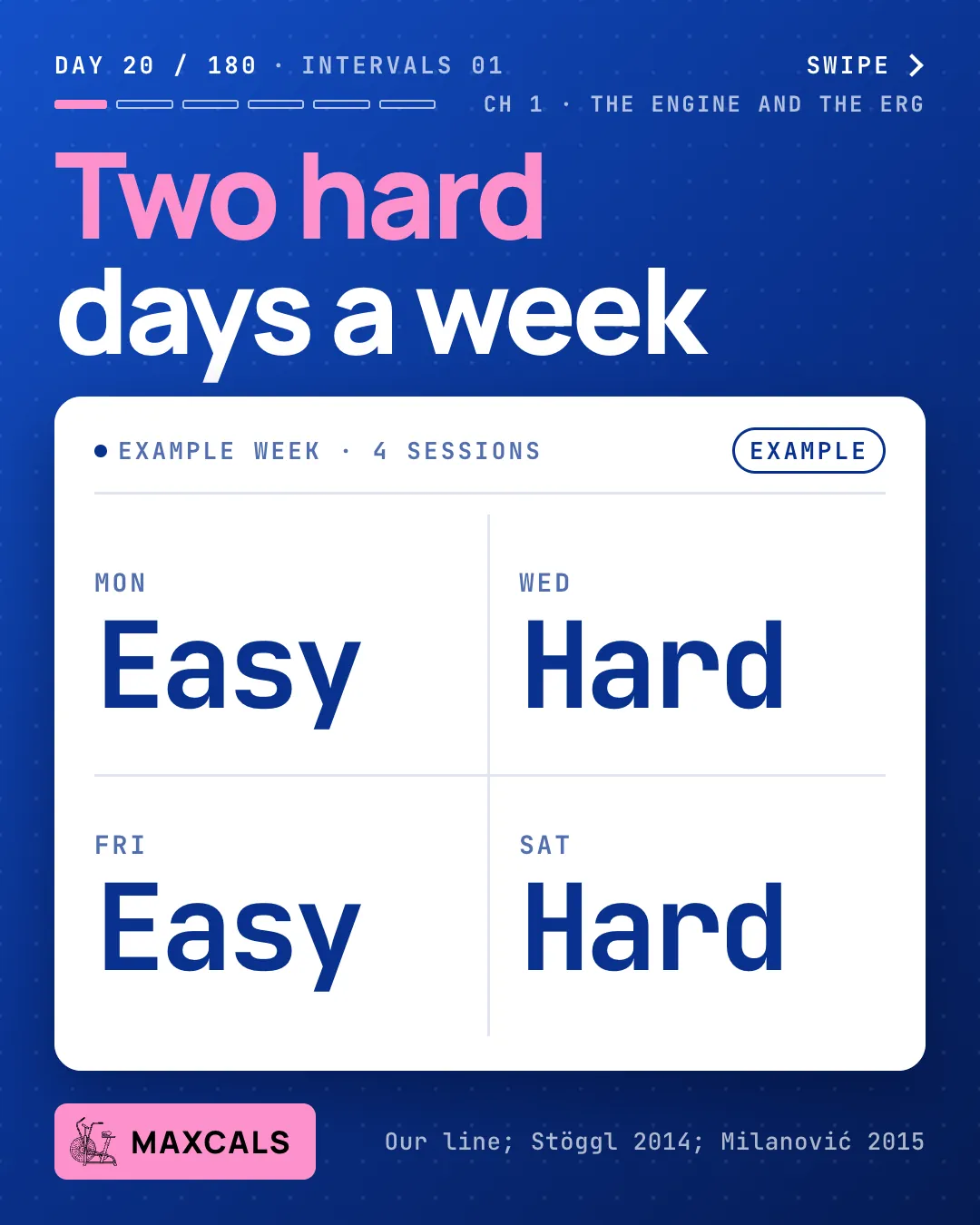
Two hard days a week
- Carousel
- The Engine
- Example
Slide 1 of 6
- Two hard days a week
- Example week · 4 sessions
- Example
- Mon: Easy
- Wed: Hard
- Fri: Easy
- Sat: Hard
Slide 2 of 6
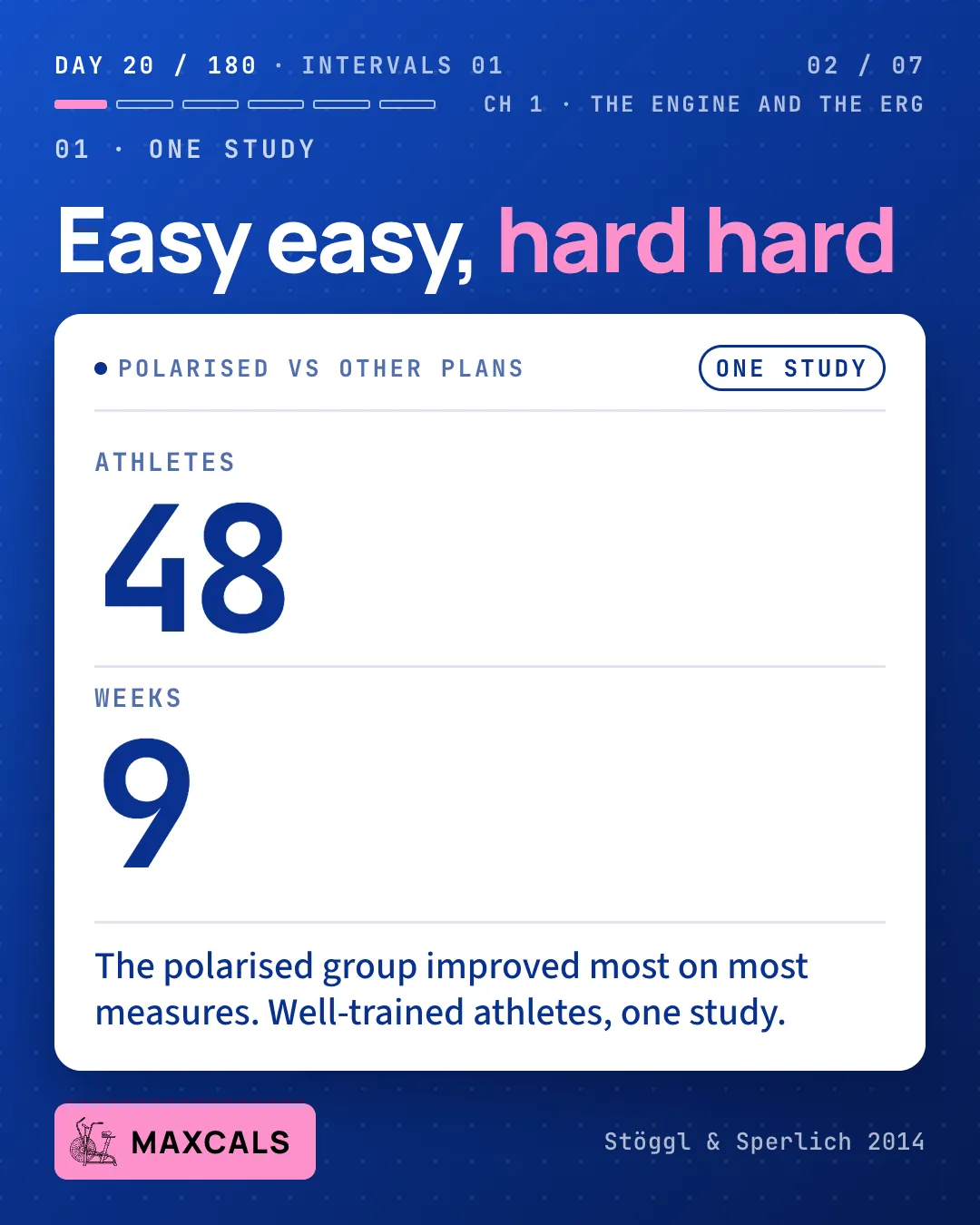
- 01 · One study
- Easy easy, hard hard
- Polarised vs other plans
- One study
- Athletes: 48
- Weeks: 9
SourceStöggl & Sperlich 2014
Slide 3 of 6
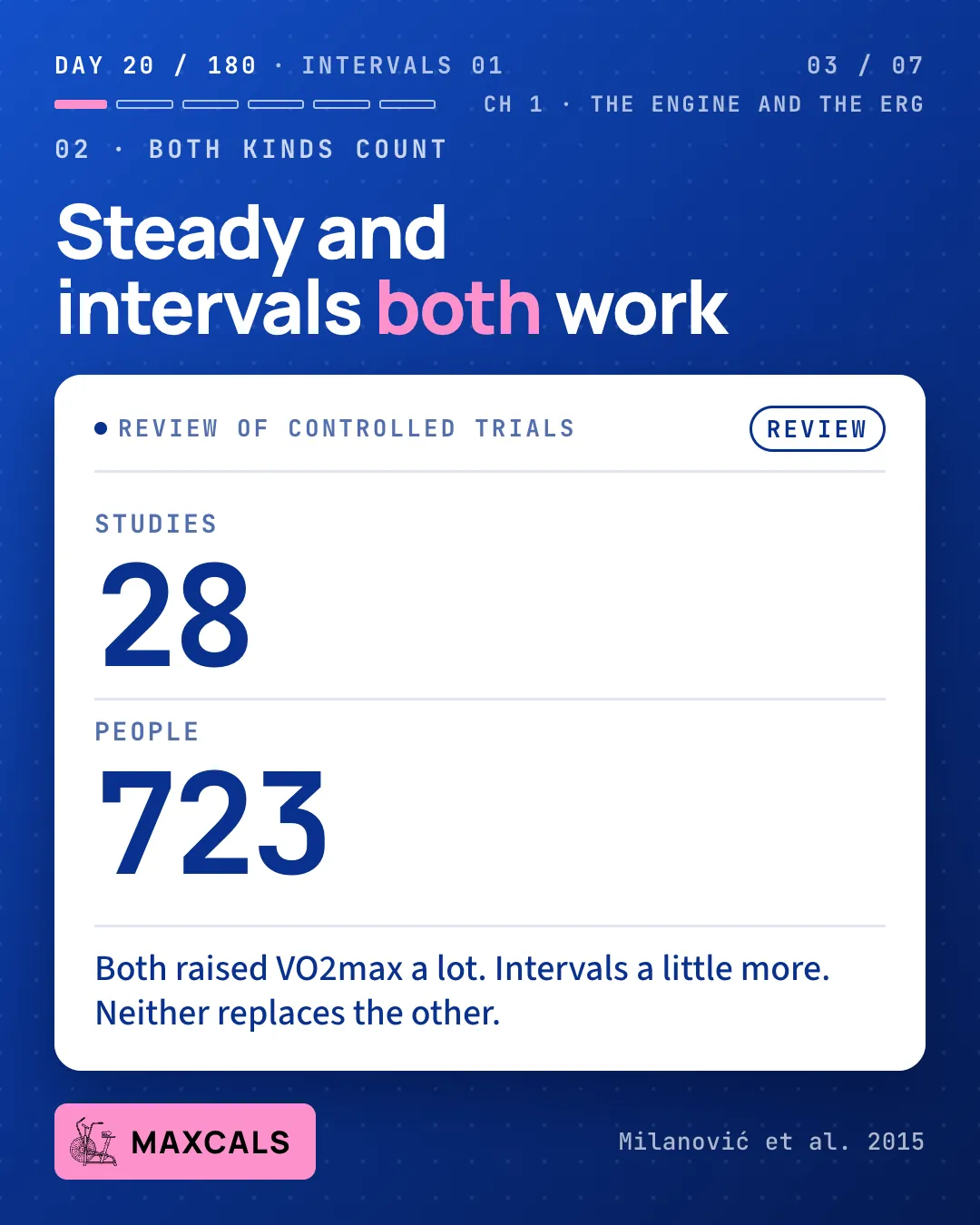
- 02 · Both kinds count
- Steady and intervals both work
- Review of controlled trials
- Review
- Studies: 28
- People: 723
SourceMilanović et al. 2015
Slide 4 of 6
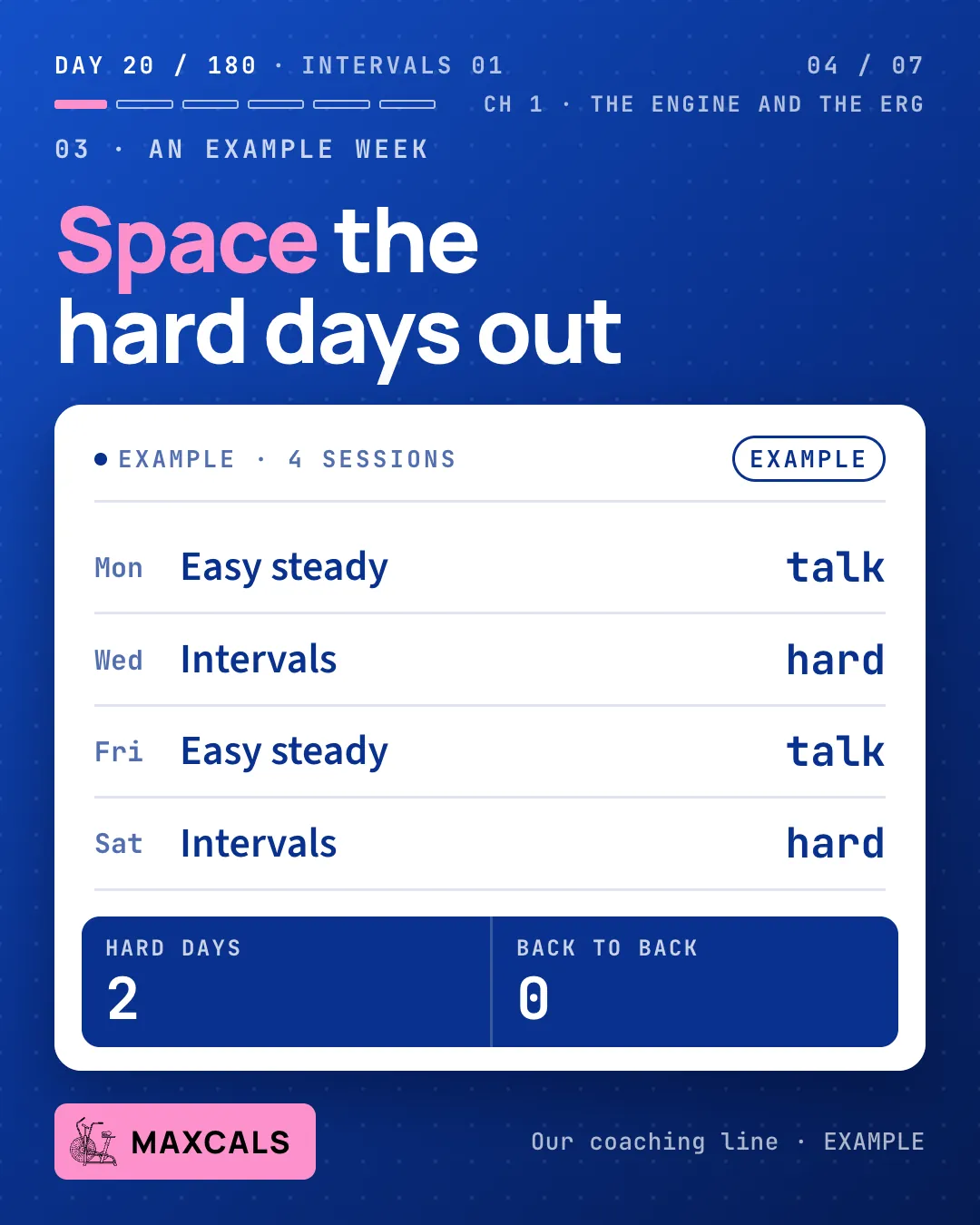
- 03 · An example week
- Space the hard days out
- Example · 4 sessions
- Example
SourceOur coaching line · EXAMPLE
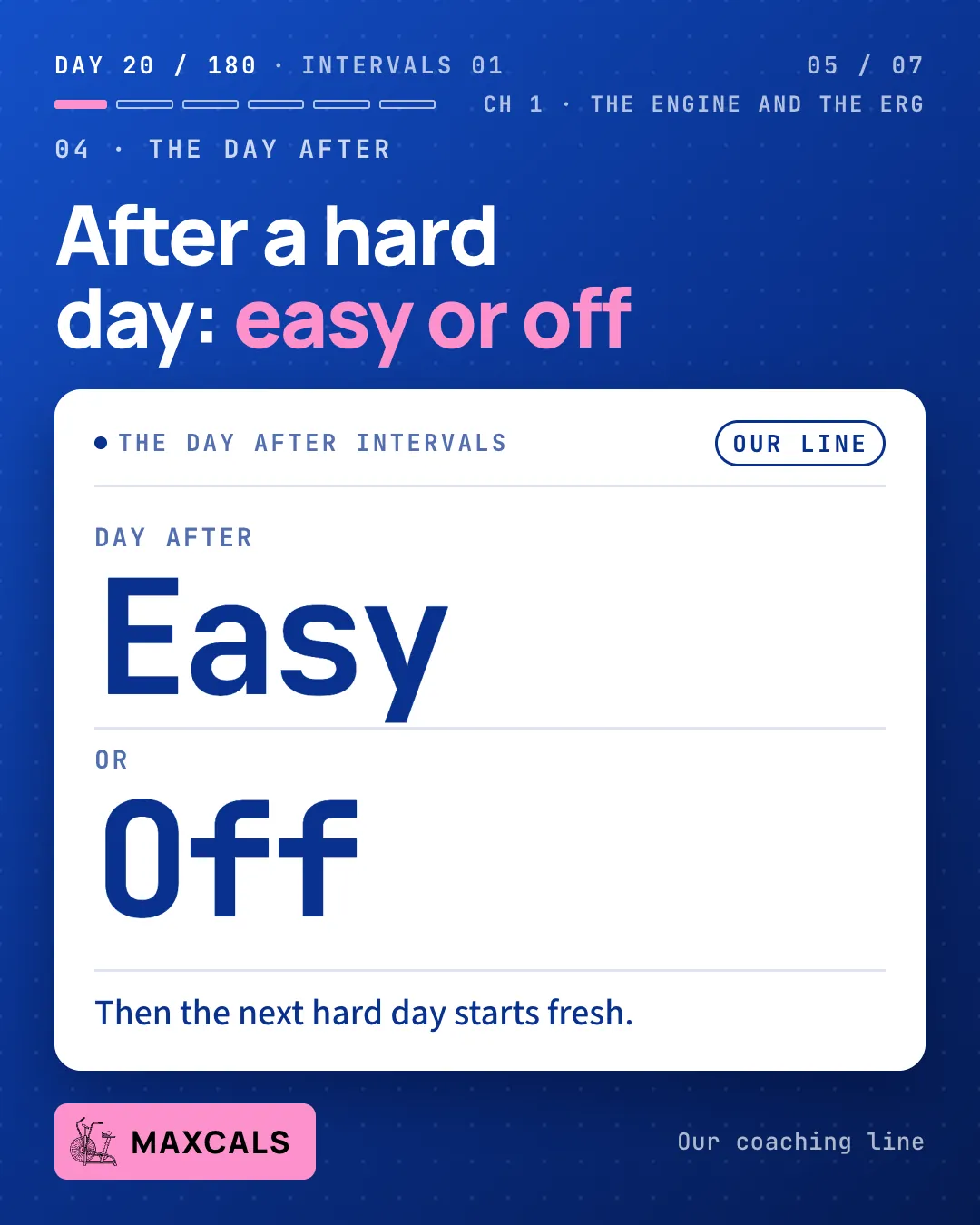
Slide 5 of 6
- 04 · The day after
- After a hard day: easy or off
- The day after intervals
- Our line
- Day after: Easy
- Or: Off
SourceOur coaching line
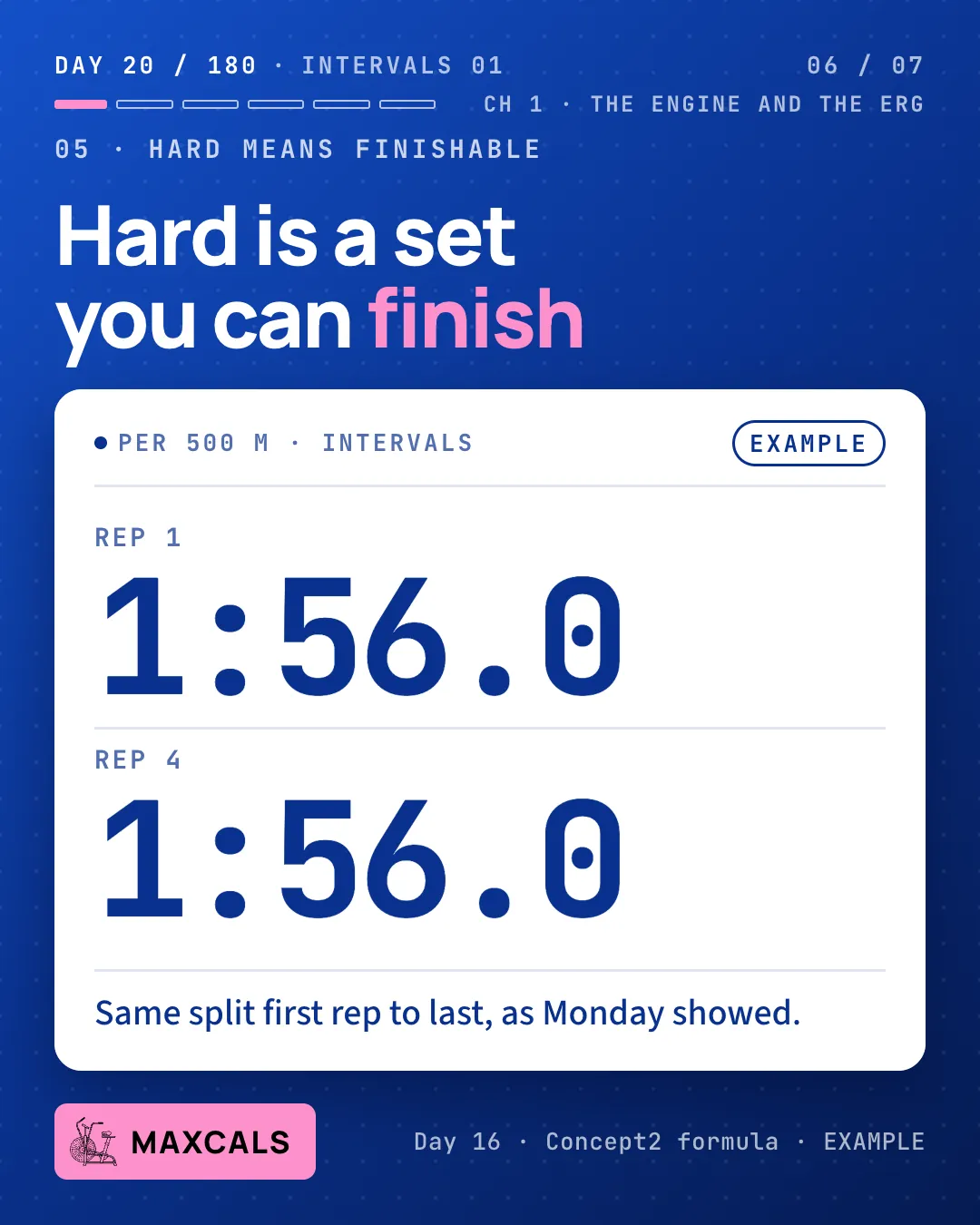
Slide 6 of 6
- 05 · Hard means finishable
- Hard is a set you can finish
- Per 500 m · intervals
- Example
- Rep 1: 1:56.0
- Rep 4: 1:56.0
SourceDay 16 · Concept2 formula · EXAMPLE
In short
Two hard erg sessions a week, with easy days around them, is one simple way to build a week.
Our line: keep the easy days easy and the hard days hard.
In one 9-week study of 48 well-trained athletes, the polarised group (lots of easy, some hard, little in between) improved most on most measures. One study, not proof it suits everyone.
A review of 28 studies found steady training and intervals both raise VO2max. Neither replaces the other.
Slide 4 has an example 4-session week. Two hard days is our coaching line, not a law.
How to run and pace each test, and how to read the result.
See the four engine testsSources
Paper
Stöggl T, Sperlich B (2014) Polarized training has greater impact on key endurance variables than threshold, high intensity, or high volume training. Front Physiol 5:33. doi 10.3389/fphys.2014.00033, PMID 24550842: 'Forty eight runners, cyclists, triathletes, and cross-country skiers'; 'over 9 weeks'; 'POL resulted in the greatest improvements in most key variables of endurance performance in well-trained endurance athletes.' No % gain shown (brand rule)
Paper
Milanović Z, Sporiš G, Weston M (2015) Sports Med 45(10):1469-1481, PMID 26243014: '28 studies', '723 participants'; 'Endurance training and HIT both elicit large improvements in the VO2max'
Ours
Our coaching line: two hard days, spaced out, with easy or off days around them; the example week is an EXAMPLE, not a prescription
Nothing here is medical advice. The tests are maximal efforts: if you have a health condition or any doubt about training this hard, check with a doctor first, and stop if you feel unwell.