01Chapter 1 · The engine and the erg
Hold the load.
- Carousel
- Myth vs Rule
- Rower
- Our rule
Slide 1 of 6
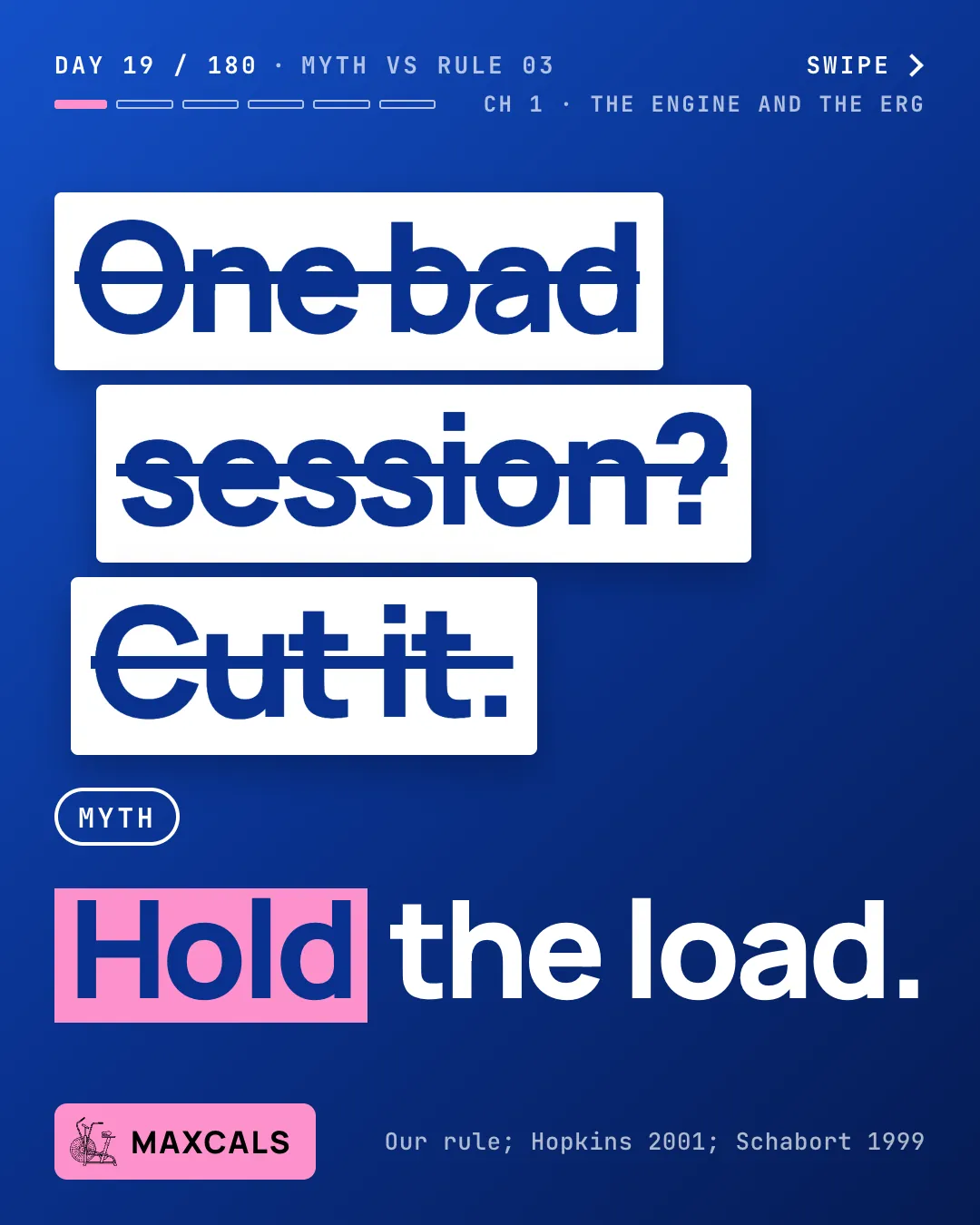
- Hold the load.
- One bad session? Cut it.

Slide 2 of 6
- Our rule
- One is noise.
- One session outside your band changes nothing.
- The next one stays the same.
SourceOur rule
Slide 3 of 6
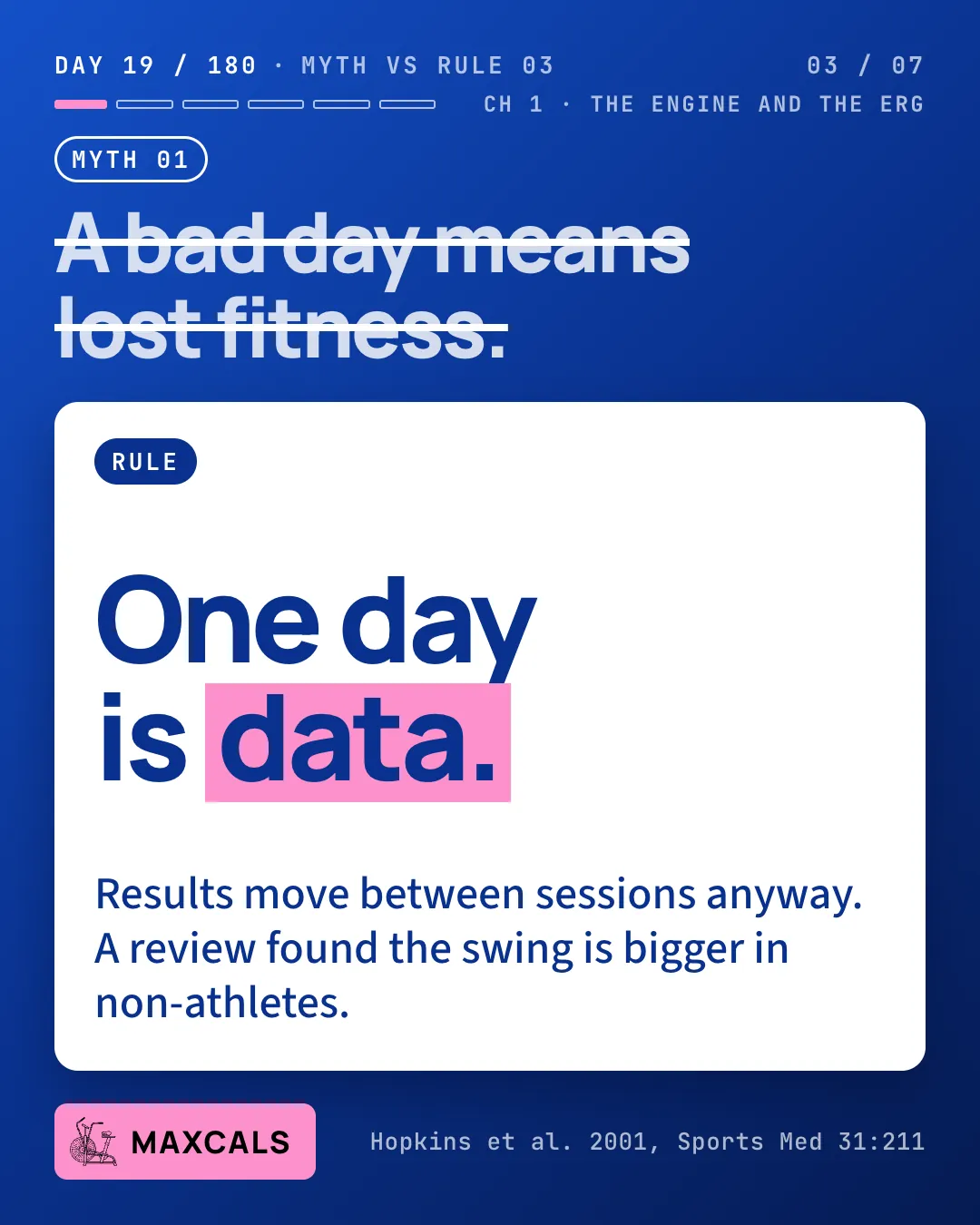
- Results move between sessions anyway. A review found the swing is bigger in non-athletes.
- Myth: A bad day means lost fitness.
- Rule: One day is data.
SourceHopkins et al. 2001, Sports Med 31:211
Slide 4 of 6
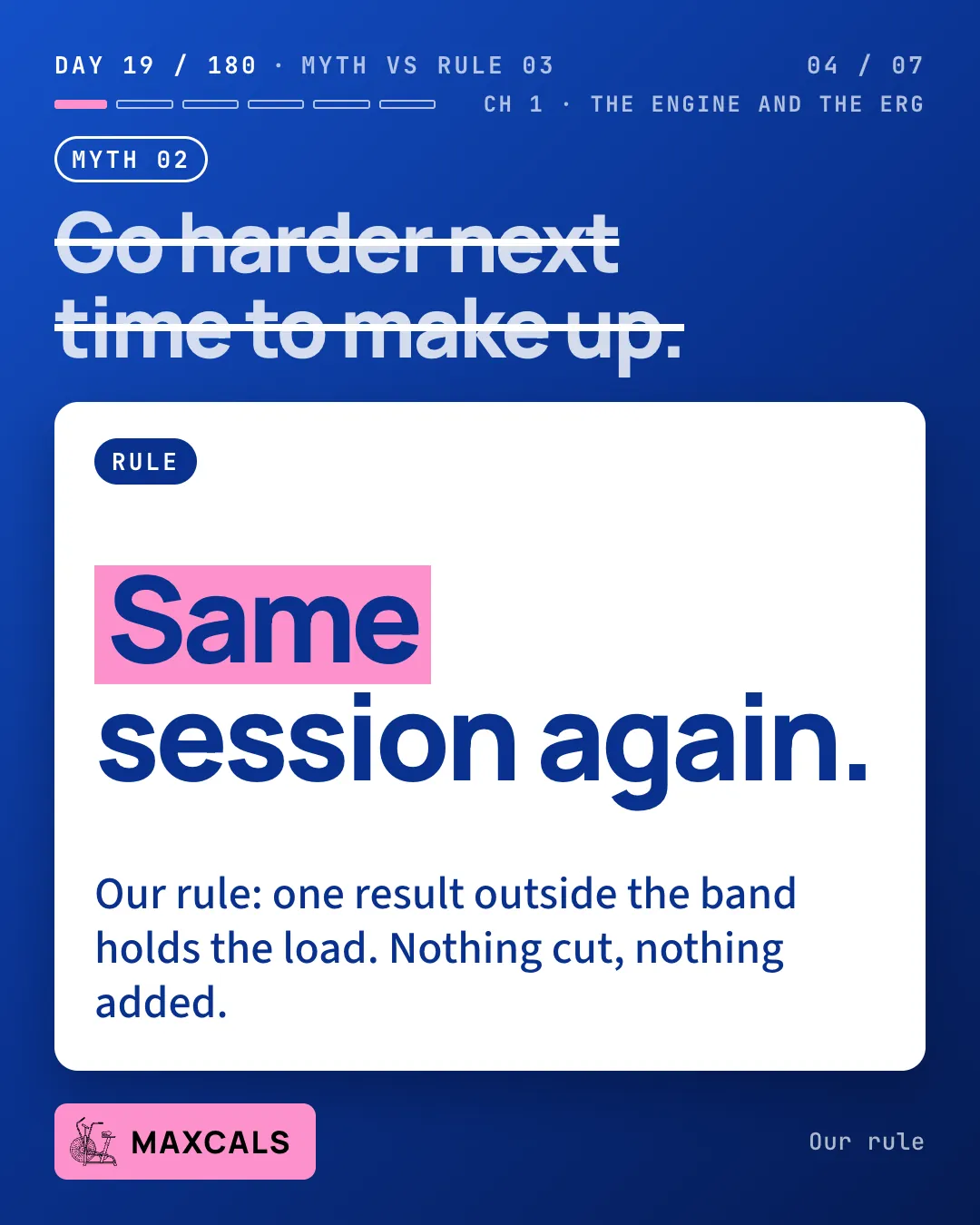
- Our rule: one result outside the band holds the load. Nothing cut, nothing added.
- Myth: Go harder next time to make up.
- Rule: Same session again.
SourceOur rule
Slide 5 of 6
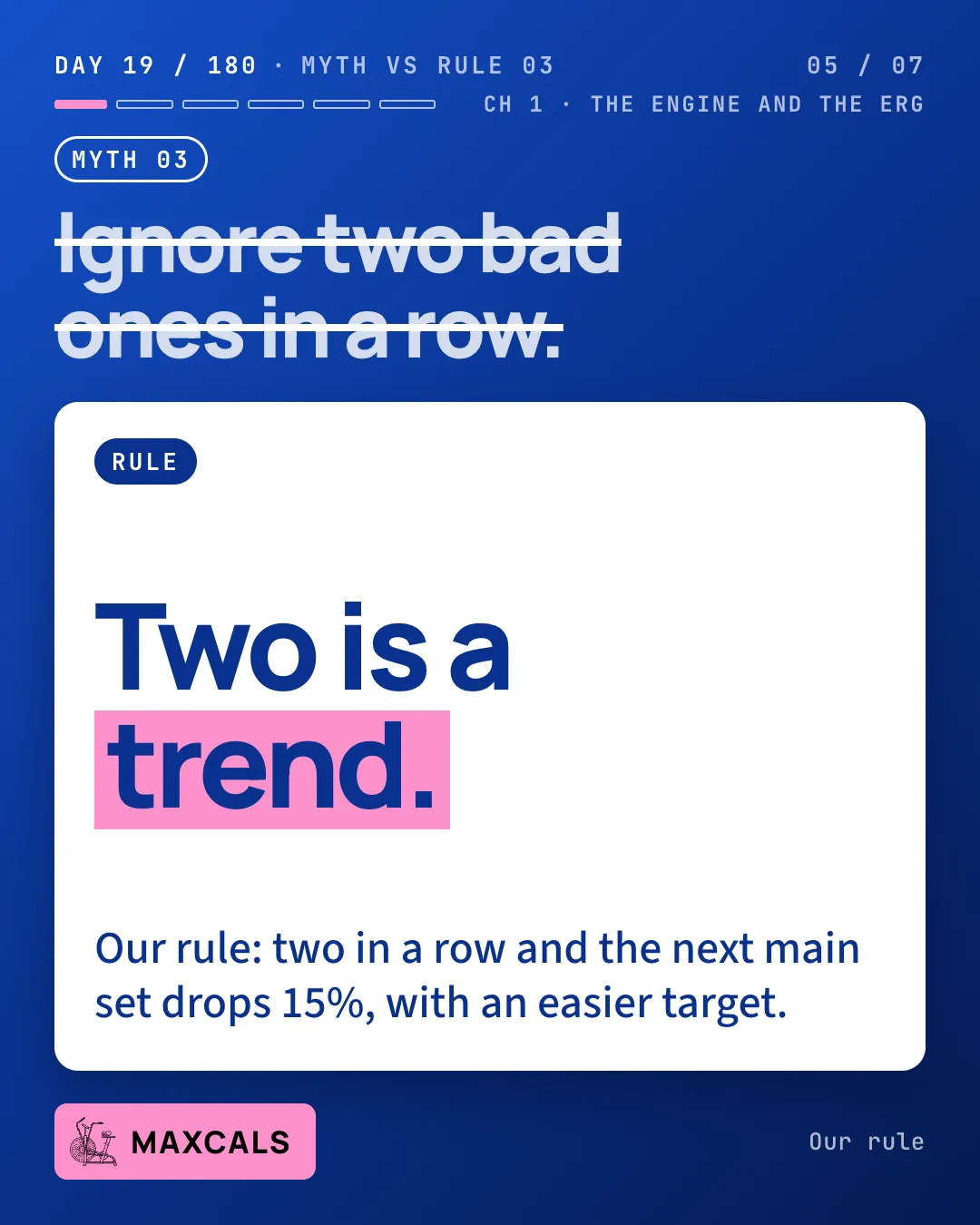
- Our rule: two in a row and the next main set drops 15%, with an easier target.
- Myth: Ignore two bad ones in a row.
- Rule: Two is a trend.
SourceOur rule
Slide 6 of 6
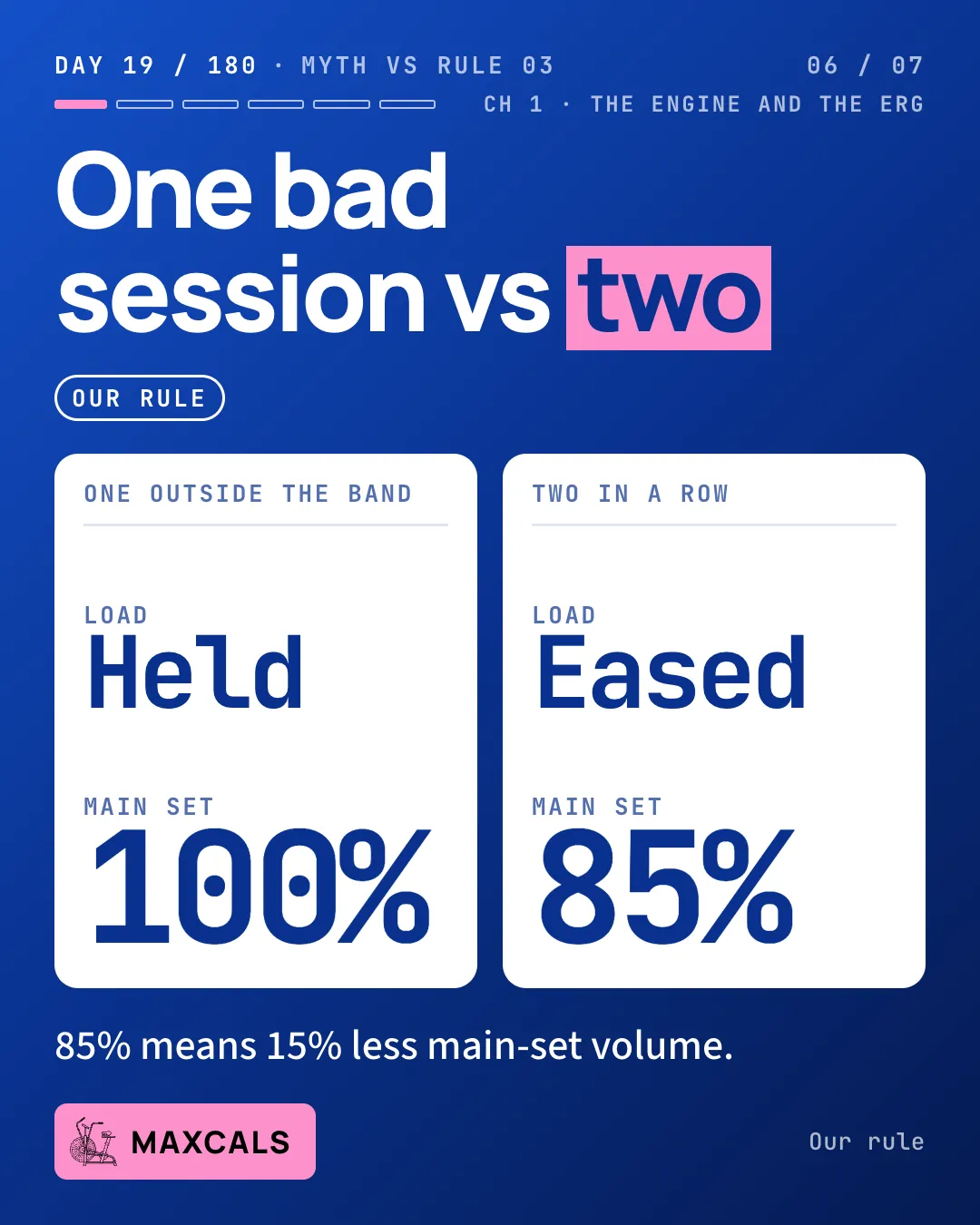
- One bad session vs two
- 85% means 15% less main-set volume.
- Our rule
- One outside the band
- Load: Held
- Main set: 100%
- Two in a row
- Load: Eased
- Main set: 85%
SourceOur rule
In short
One bad session. What should happen to the next one?
Our rule: one result outside your band holds the load. Nothing gets cut and nothing gets added.
Two in a row is a trend. Then the next main set drops 15%, with an easier target.
Why wait for two? Results move from session to session anyway. In one study, well-trained rowers varied by about 2% in mean power across repeat 2k tests, and a review found that variation is larger in non-athletes.
One bad day is data, not a verdict.
How to run and pace each test, and how to read the result.
See the four engine testsSources
Paper
Schabort EJ, Hawley JA, Hopkins WG, Blum H (1999) J Sports Sci 17(8):627-632, doi 10.1080/026404199365650, PMID 10487463: eight well-trained rowers, three 2000-m trials, 'the coefficient of variation for mean power was 2.0%'
Paper
Hopkins WG, Schabort EJ, Hawley JA (2001) Reliability of power in physical performance tests. Sports Med 31(3):211-234, doi 10.2165/00007256-200131030-00005, PMID 11286357: variation 'larger for nonathletes versus athletes (1.3 x)'
Worked out
Computed: 15% less main set = 85%
Ours
Our rules: MaxCals rules, not research findings. Each is labelled OUR RULE.
Nothing here is medical advice. The tests are maximal efforts: if you have a health condition or any doubt about training this hard, check with a doctor first, and stop if you feel unwell.