01Chapter 1 · The engine and the erg
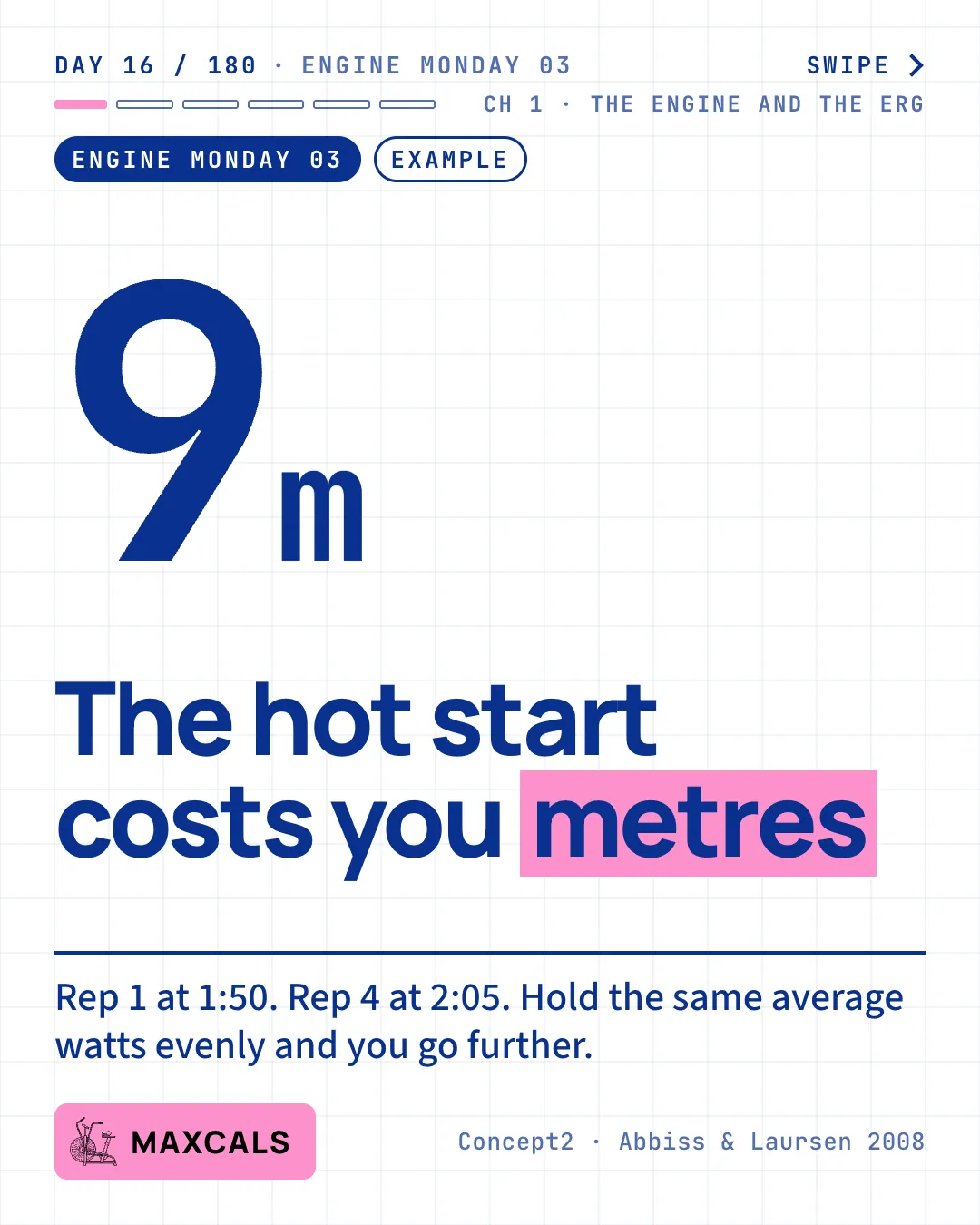
The hot start costs you metres
- Carousel
- The Engine
- Rower
- Example
Slide 1 of 6
- Example
- The hot start costs you metres
- 9 m
- Rep 1 at 1:50. Rep 4 at 2:05. Hold the same average watts evenly and you go further.
Slide 2 of 6
- Rower A
- Example
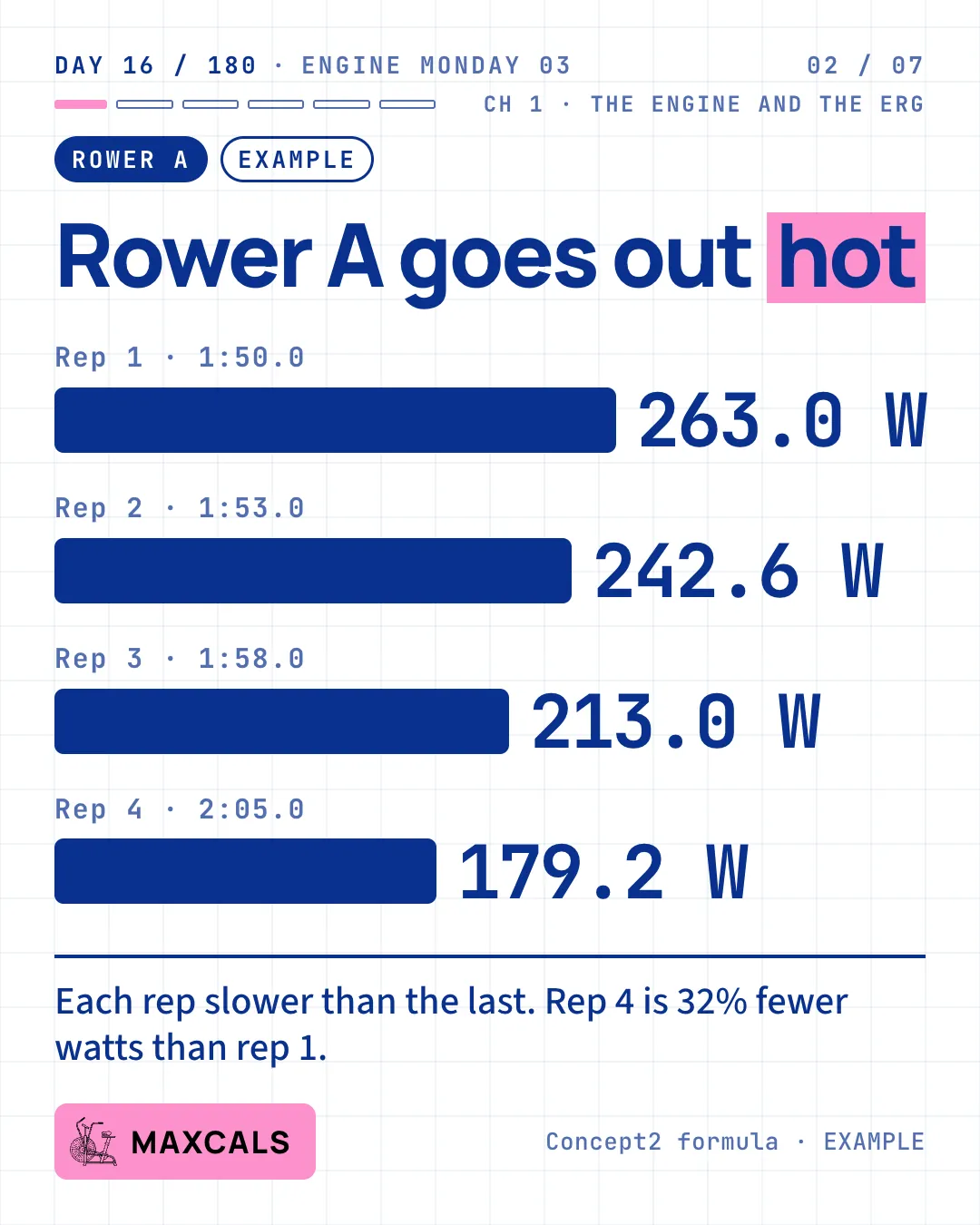
- Rower A goes out hot
- Each rep slower than the last. Rep 4 is 32% fewer watts than rep 1.
- Rep 1 · 1:50.0 - 263.0 W
- Rep 2 · 1:53.0 - 242.6 W
- Rep 3 · 1:58.0 - 213.0 W
- Rep 4 · 2:05.0 - 179.2 W
SourceConcept2 formula · EXAMPLE
Slide 3 of 6
- Rower B
- Example
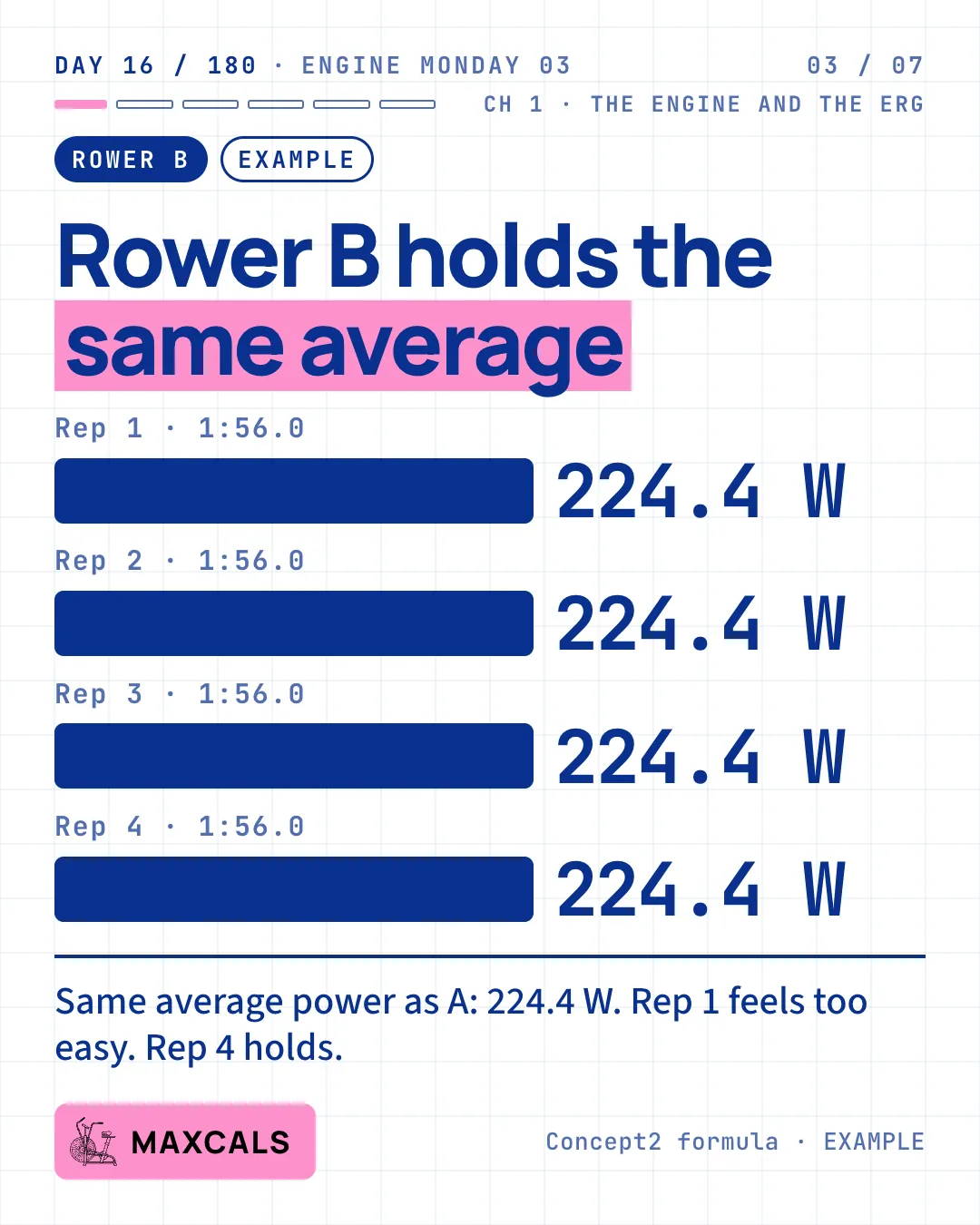
- Rower B holds the same average
- Same average power as A: 224.4 W. Rep 1 feels too easy. Rep 4 holds.
- Rep 1 · 1:56.0 - 224.4 W
- Rep 2 · 1:56.0 - 224.4 W
- Rep 3 · 1:56.0 - 224.4 W
- Rep 4 · 1:56.0 - 224.4 W
SourceConcept2 formula · EXAMPLE
Slide 4 of 6
- 16 minutes of work
- Example
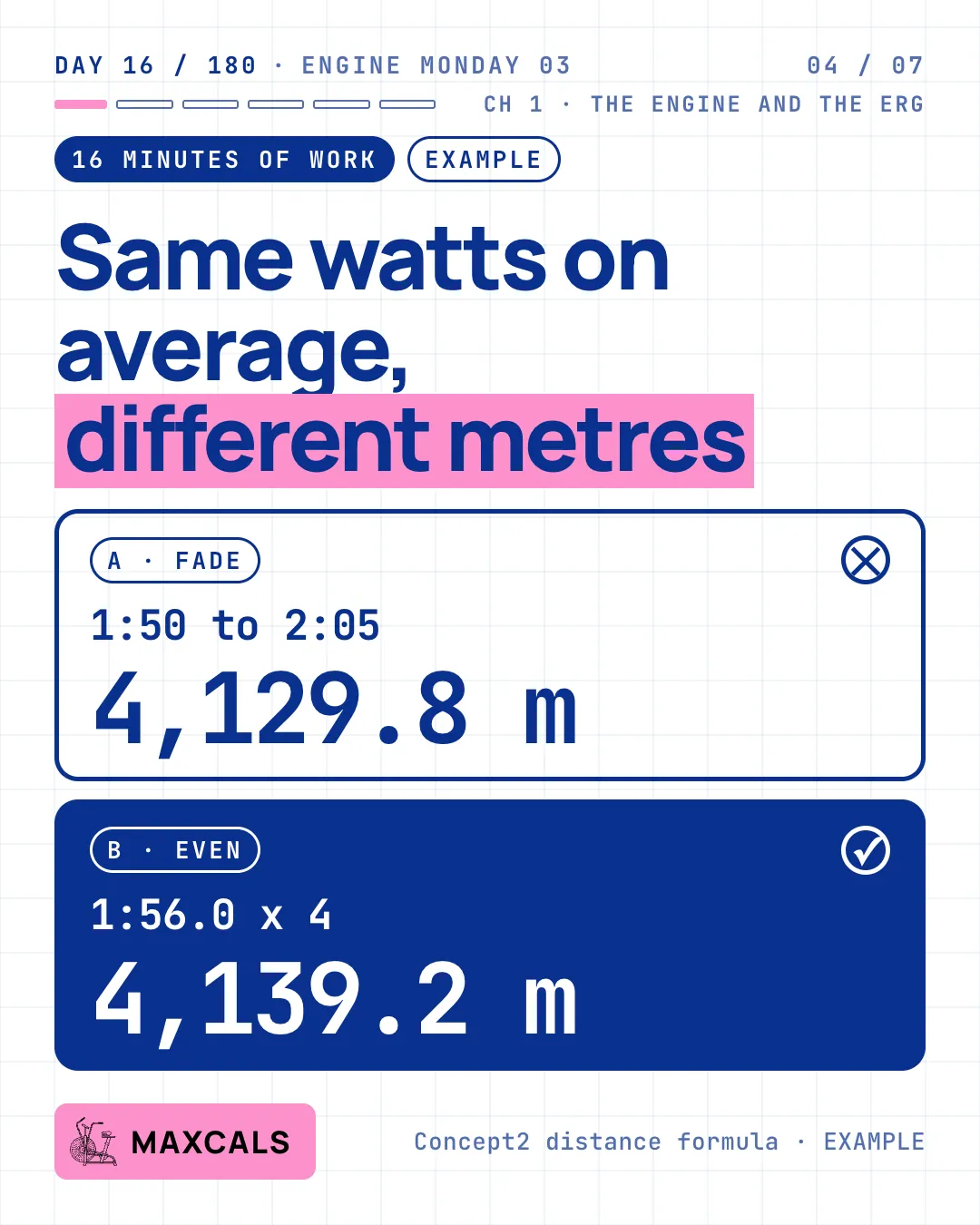
- Same watts on average, different metres
SourceConcept2 distance formula · EXAMPLE
Slide 5 of 6
- The cost
- Example
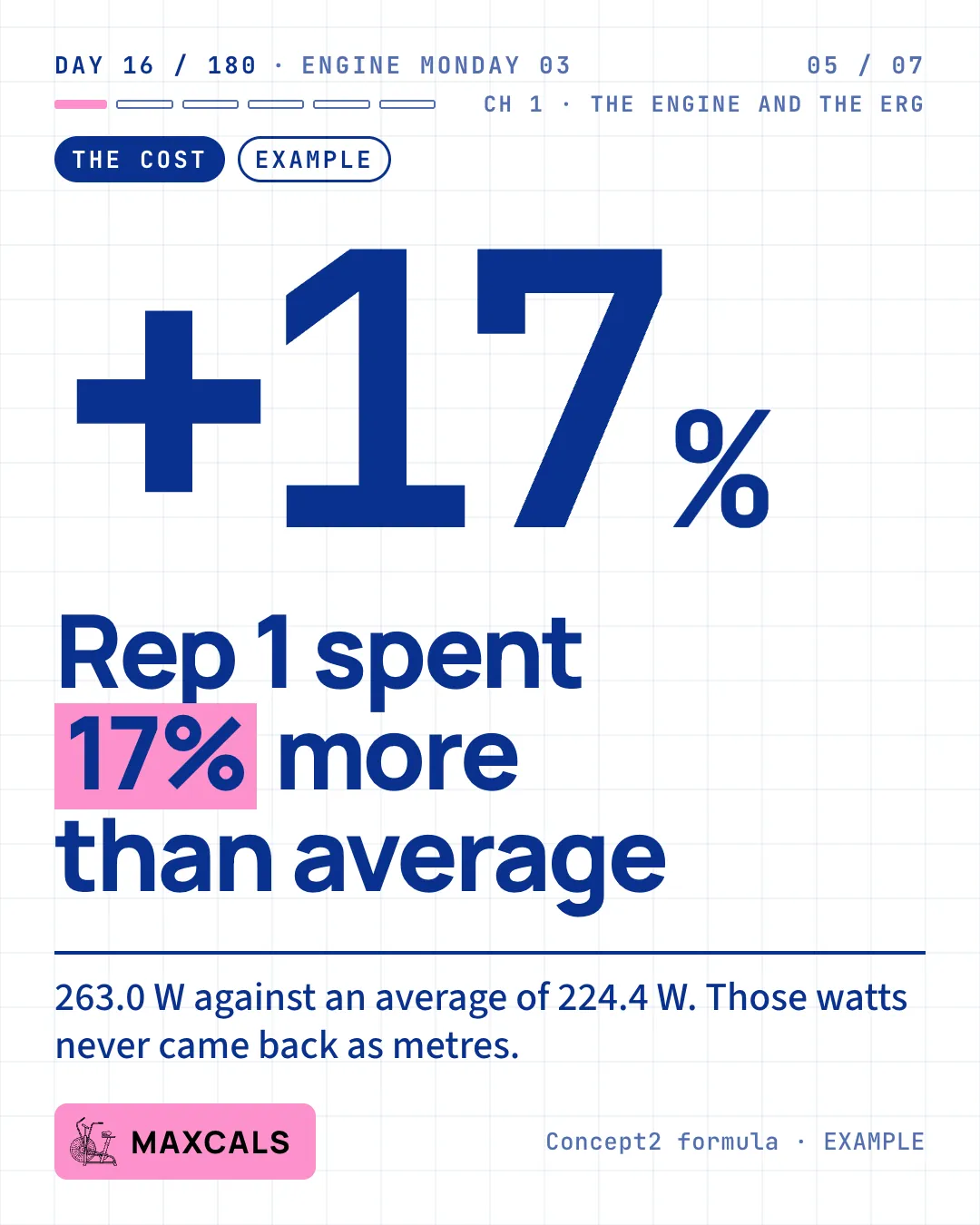
- Rep 1 spent 17% more than average
- +17 %
- 263.0 W against an average of 224.4 W. Those watts never came back as metres.
SourceConcept2 formula · EXAMPLE
Slide 6 of 6
- Pacing review
- Over 2 minutes
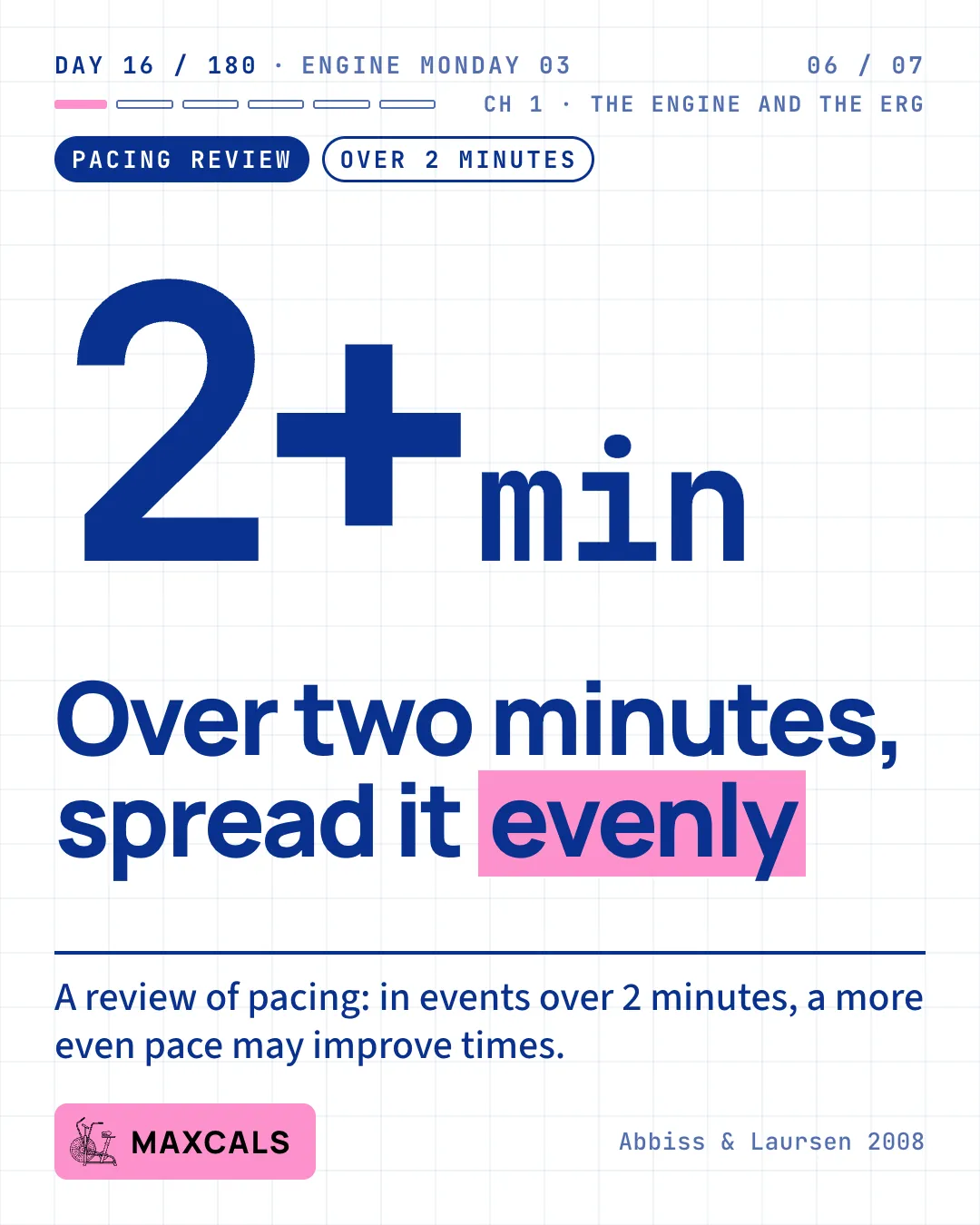
- Over two minutes, spread it evenly
- 2+ min
- A review of pacing: in events over 2 minutes, a more even pace may improve times.
SourceAbbiss & Laursen 2008
In short
Rep 1 at 1:50. Rep 4 at 2:05. The hot start costs you metres.
Over four 4-minute reps, rower A fades: 1:50, 1:53, 1:58, 2:05. That averages 224.4 W.
Rower B holds the same average watts, evenly: 1:56.0 every rep. B goes about 9 m further for the same power.
That's the cube law at work. A's hot first rep spent 17% more watts than the average and never got them back in metres.
A pacing review: in events over 2 minutes, a more even pace may improve times.
Every split is an example. Every number comes from Concept2's formula.
Turn pace into watts, and watts into pace, on any Concept2 erg.
Open the machine converterSources
Concept2 / web
Concept2 Watts Calculator / Pace Calculator (concept2.com/training/watts-calculator; /pace-calculator, fetched 31 Oct 2026): 'watts = 2.8/(split/500)³'; 'distance = (time/split) * 500'
Worked out
Computed EXAMPLE, rower A, 4 x 240 s at 1:50.0/1:53.0/1:58.0/2:05.0: 263.0, 242.6, 213.0, 179.2 W; metres 1090.9, 1061.9, 1016.9, 960.0 = 4129.8 m; mean power 224.44 W (equal 240 s reps, so time-weighted)
Worked out
Computed EXAMPLE, rower B, same mean power held evenly: split = 500 x (2.80/224.44)^(1/3) = 115.96 s = 1:56.0; 960 s / 115.96 x 500 = 4139.2 m; gap 9.4 m
Worked out
Computed: rep 1 263.0 W vs mean 224.4 W = +17.2% (shown 17%); rep 4 vs rep 1 = -31.9%
Paper
Abbiss CR, Laursen PB (2008) Describing and understanding pacing strategies during athletic competition. Sports Med 38(3):239-252. doi 10.2165/00007256-200838030-00004, PMID 18278984: 'during prolonged events (>2 minutes), performance times may be improved if athletes distribute their pace more evenly'
Nothing here is medical advice. The tests are maximal efforts: if you have a health condition or any doubt about training this hard, check with a doctor first, and stop if you feel unwell.