01Chapter 1 · The engine and the erg
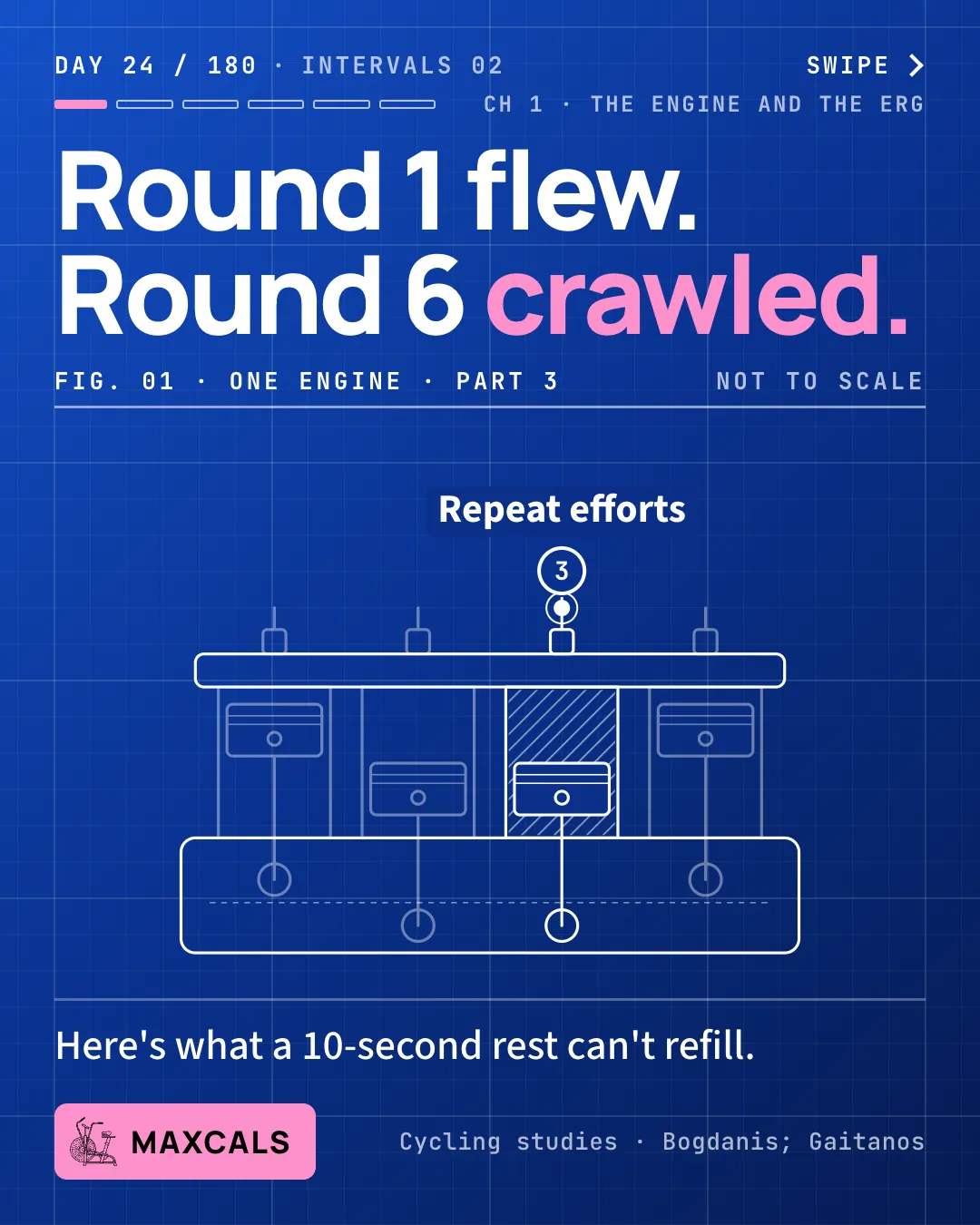
Round 1 flew. Round 6 crawled.
- Carousel
- The Engine
Slide 1 of 6
- Round 1 flew. Round 6 crawled.
- Here's what a 10-second rest can't refill.
- Repeat efforts
Slide 2 of 6
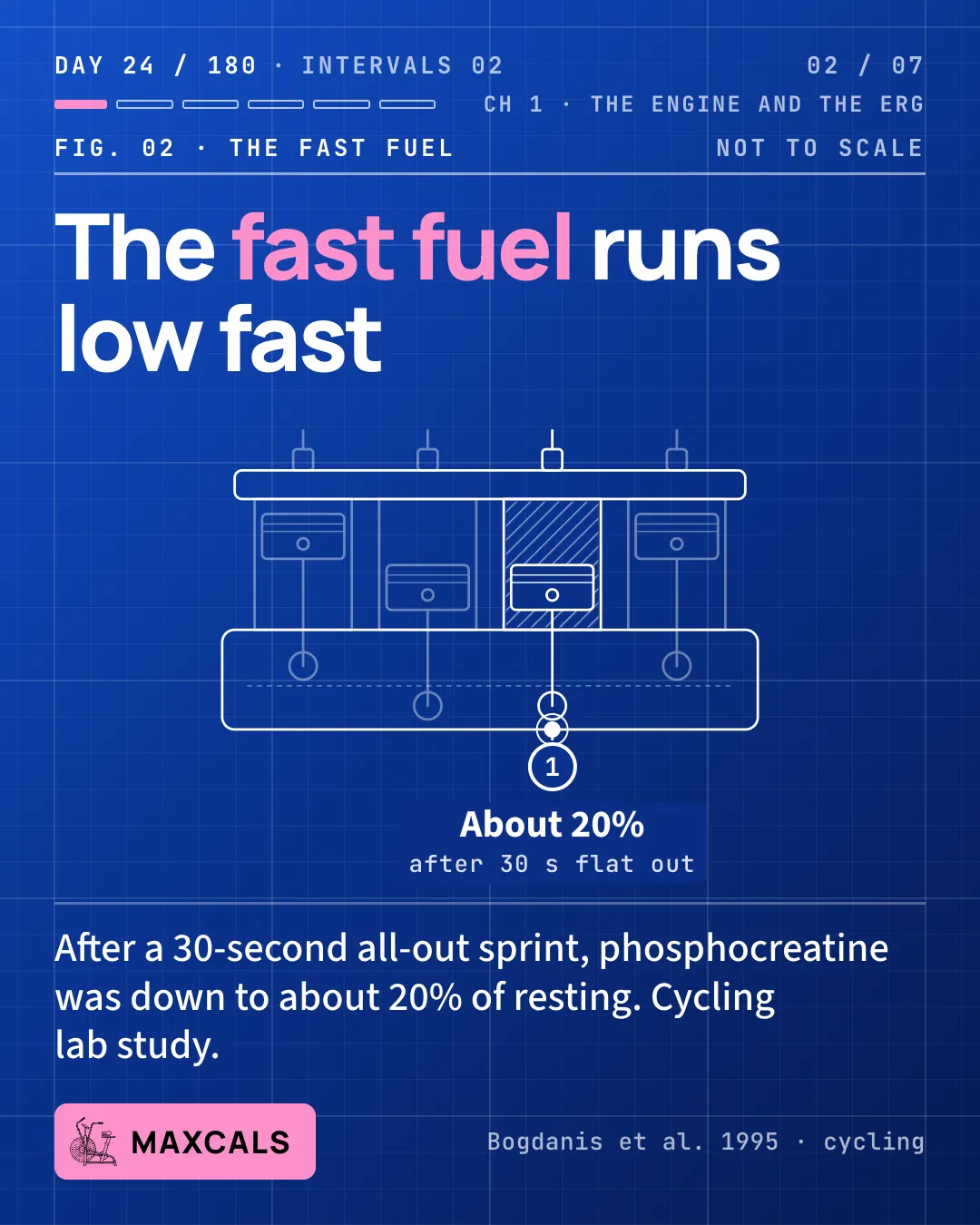
- Fig. 02 · The fast fuel
- The fast fuel runs low fast
- After a 30-second all-out sprint, phosphocreatine was down to about 20% of resting. Cycling lab study.
- About 20%
- after 30 s flat out
SourceBogdanis et al. 1995 · cycling
Slide 3 of 6
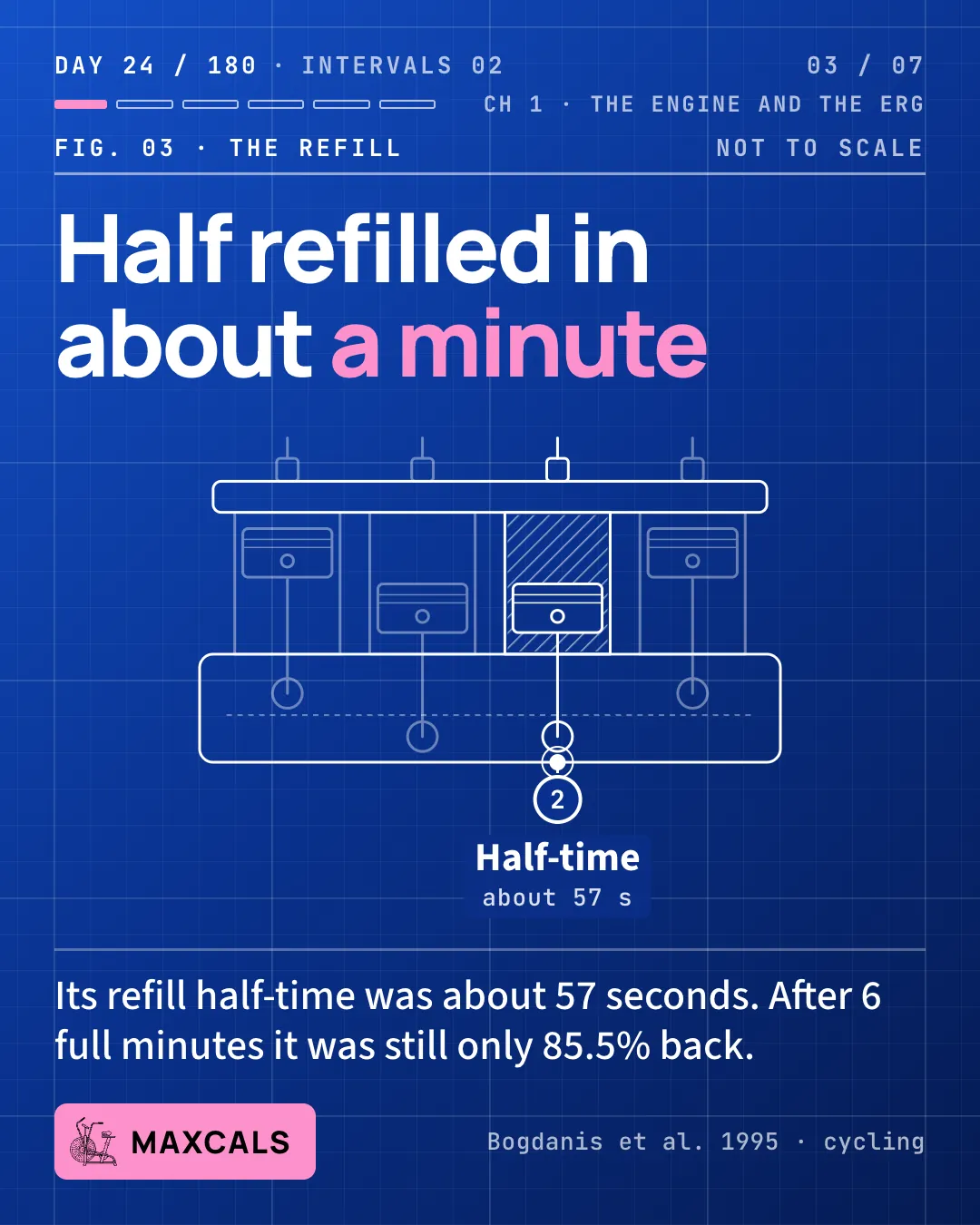
- Fig. 03 · The refill
- Half refilled in about a minute
- Its refill half-time was about 57 seconds. After 6 full minutes it was still only 85.5% back.
- Half-time
- about 57 s
SourceBogdanis et al. 1995 · cycling
Slide 4 of 6
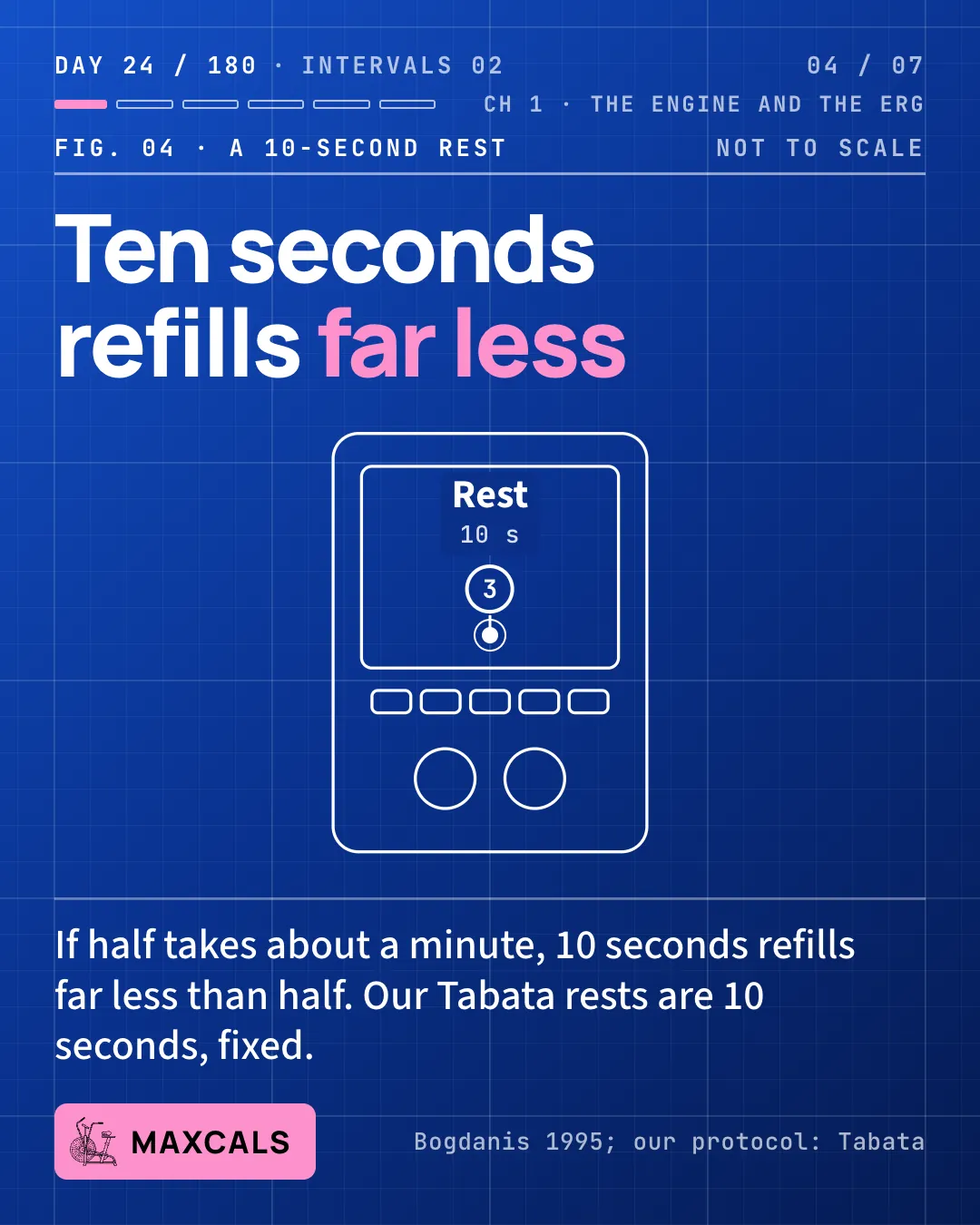
- Fig. 04 · A 10-second rest
- Ten seconds refills far less
- If half takes about a minute, 10 seconds refills far less than half. Our Tabata rests are 10 seconds, fixed.
- Rest
- 10 s
SourceBogdanis 1995; our protocol: Tabata
Slide 5 of 6
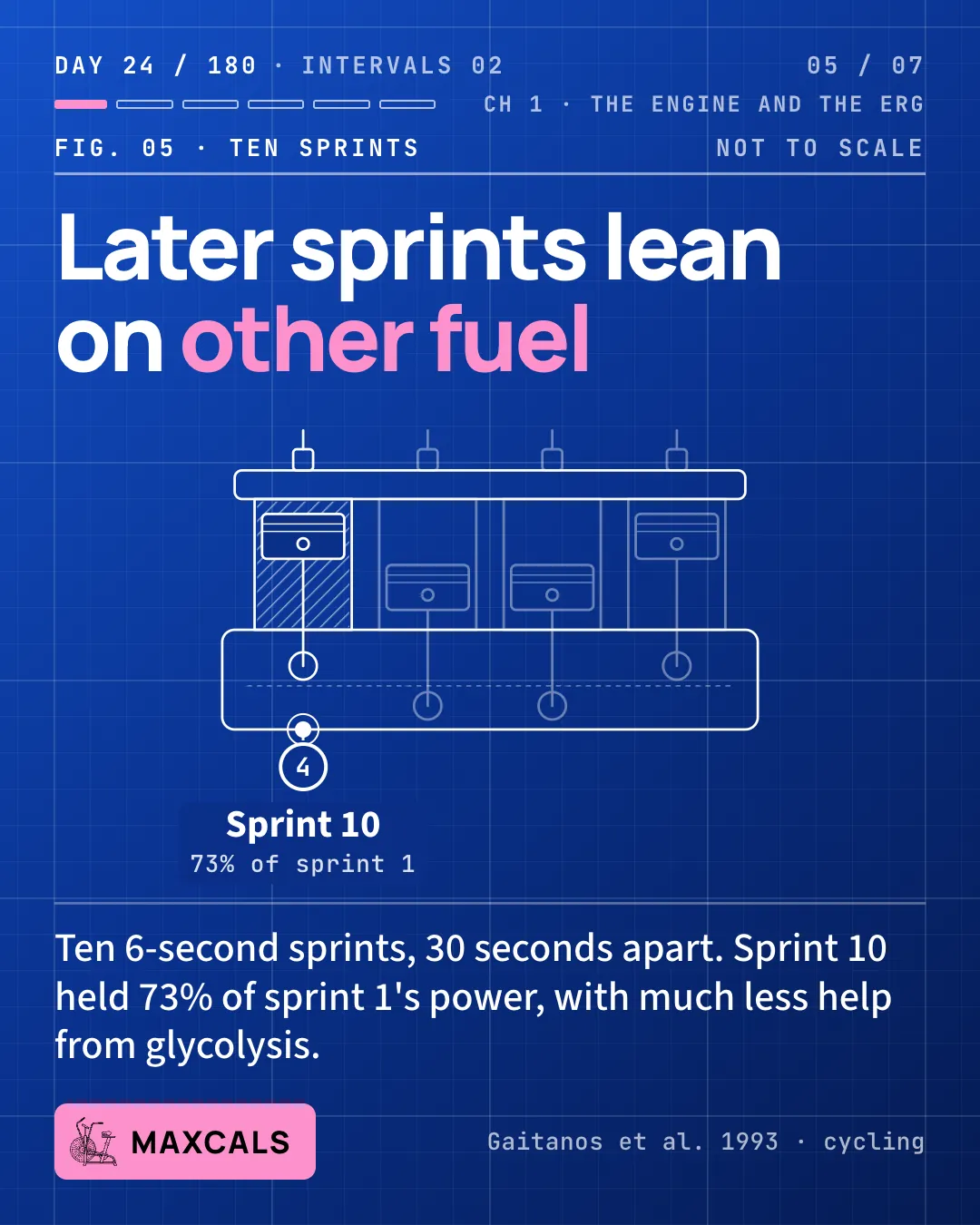
- Fig. 05 · Ten sprints
- Later sprints lean on other fuel
- Ten 6-second sprints, 30 seconds apart. Sprint 10 held 73% of sprint 1's power, with much less help from glycolysis.
- Sprint 10
- 73% of sprint 1
SourceGaitanos et al. 1993 · cycling
Slide 6 of 6
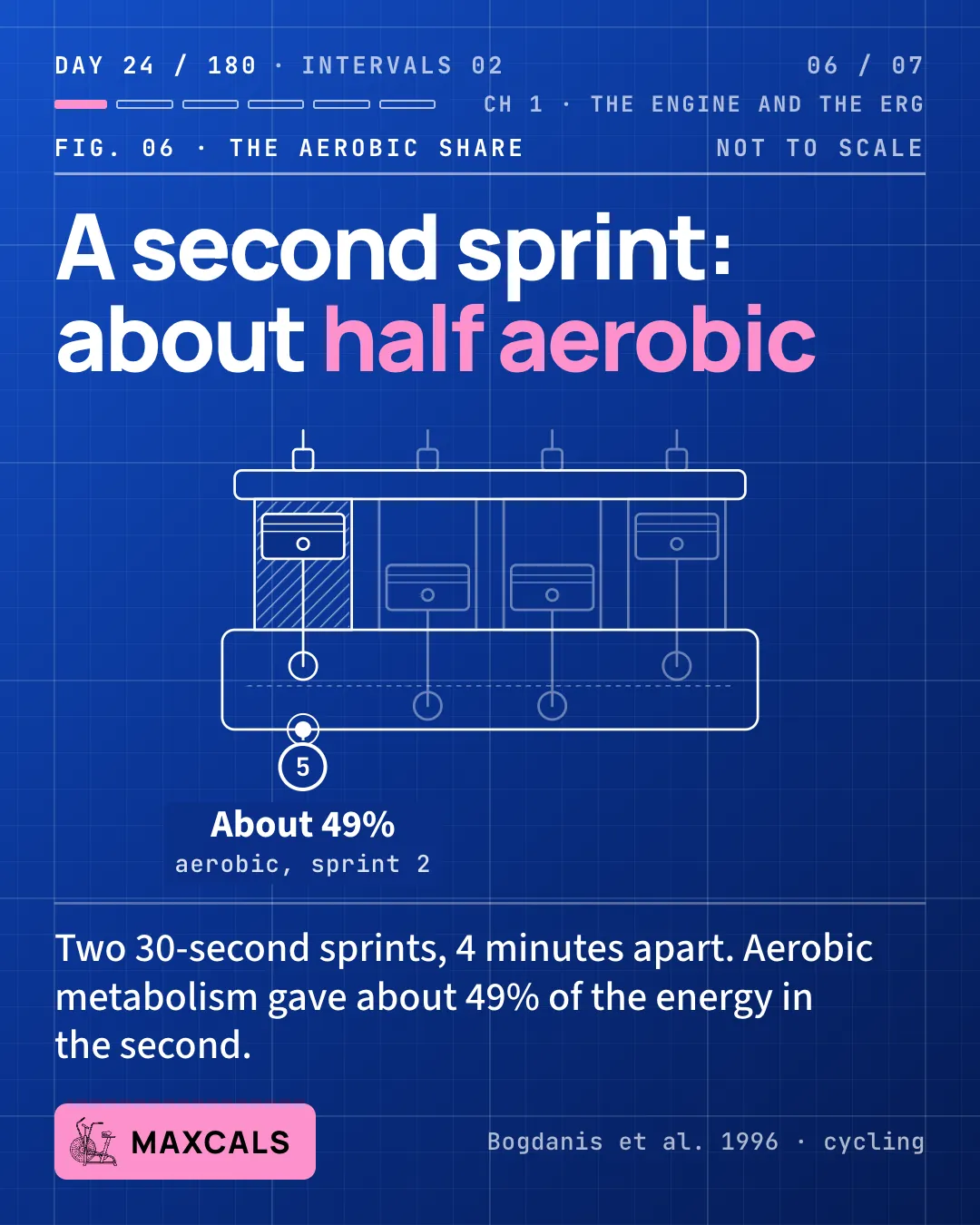
- Fig. 06 · The aerobic share
- A second sprint: about half aerobic
- Two 30-second sprints, 4 minutes apart. Aerobic metabolism gave about 49% of the energy in the second.
- About 49%
- aerobic, sprint 2
SourceBogdanis et al. 1996 · cycling
In short
Round 1 flew. Round 6 crawled. Here's what a 10-second rest can't refill.
The fast fuel for a sprint is phosphocreatine. In a cycling lab study it was down to about 20% of resting after a 30-second all-out sprint, and took about a minute to refill halfway.
So a 10-second rest refills far less than half.
In another cycling study, ten 6-second sprints with 30 seconds' rest: the tenth still held 73% of the first sprint's power, with much less help from glycolysis. The authors suggest more came from aerobic metabolism.
In those cycling studies, later sprints leaned more on aerobic energy. Our Tabata rests are 10 seconds, fixed. In chapter 2 we read round 8 against round 1.
How to run and pace each test, and how to read the result.
See the four engine testsSources
Paper
Bogdanis GC, Nevill ME, Boobis LH, Lakomy HK, Nevill AM (1995) Recovery of power output and muscle metabolites following 30 s of maximal sprint cycling in man. J Physiol 482(Pt 2):467-480. doi 10.1113/jphysiol.1995.sp020533, PMID 7714837: 'At the end of the 30 s sprint phosphocreatine (PCr) ... 19.7 +/- 1.2 ... % of the resting values'; 'PCr increased rapidly to 65.0 +/- 2.8% of rest after 1.5 min, but reached only 85.5 +/- 3.5% of rest after 6 min'; 'an average half-time for PCr resynthesis of 56.6 +/- 7.3 s'
Paper
Gaitanos GC, Williams C, Boobis LH, Brooks S (1993) Human muscle metabolism during intermittent maximal exercise. J Appl Physiol 75(2):712-719. doi 10.1152/jappl.1993.75.2.712, PMID 8226473: 'ten 6-s maximal sprints with 30 s of recovery'; 'in the tenth sprint ... MPO was reduced only to 73% of that generated in the first sprint'; 'a considerable reduction in the contribution of anaerobic glycogenolysis'; 'it was suggested that, during the last sprint, power output was supported by energy that was mainly derived from PCr degradation and an increased aerobic metabolism'
Paper
Bogdanis GC, Nevill ME, Boobis LH, Lakomy HK (1996) Contribution of phosphocreatine and aerobic metabolism to energy supply during repeated sprint exercise. J Appl Physiol 80(3):876-884. doi 10.1152/jappl.1996.80.3.876, PMID 8964751: 'aerobic metabolism provides a significant part (approximately 49%) of the energy during the second sprint' (two 30-s cycling sprints, 4 min apart; slide 6, labelled with its 4-minute rest so it doesn't stand in for a 10-second rest)
Ours
Our test protocol: the four engine tests as set out on the Engine tests page.
Nothing here is medical advice. The tests are maximal efforts: if you have a health condition or any doubt about training this hard, check with a doctor first, and stop if you feel unwell.